Most aspirants start their JEE preparation by solving every problem step-by-step because that’s how real understanding develops. And that’s the right approach, the teacher asks to follow. Tricks and shortcuts only make sense once the core idea is clear.
But once the core idea is clear, you start spotting patterns like repetitive steps, predictable traps, and places where time disappears. Students gain an understanding of when to use shortcuts.
This blog will help JEE aspirants by providing essential physics shortcuts and tricks that simplify complex topics and save valuable time during exams. Here you will also learn key problem-solving strategies for mechanics, electrodynamics, optics, modern physics, and more.
Fundamental Concepts to Master Before Applying Shortcuts
Before diving into shortcuts, there are certain physics concepts for JEE that you must first grasp. Understanding these basic principles is crucial, as shortcuts rely on them.
Kinematics
Kinematics is the study of motion, a fundamental part of mechanics. Understanding concepts such as displacement, velocity, and acceleration, and mastering the equations of motion, are essential.
Work, Energy, and Power
These concepts explain how forces lead to motion and how energy is transferred. Being clear about energy conservation and the work-energy theorem will help you solve problems more efficiently.
Electrostatics and Electrodynamics
These branches of electricity and magnetism deal with forces and fields. They require a solid understanding of Coulomb’s law, Gauss’s law, and Kirchhoff’s laws for circuits.
Points to Remember:
• Avoid shortcuts without conceptual understanding first.
• Practice standard forms before applying trick variations.
• Strengthen visualisation for faster pattern recognition.
Shortcuts Used in Mechanics
Shortcuts work well only when basic concepts are solid. Strong fundamentals allow faster thinking under exam pressure. Students must understand concepts such as motion, force, energy, electricity, and light.
Here are some of the concepts with shortcuts:
Kinematics
Instead of memorising multiple kinematic equations, use the concept of relative motion. Often, two objects moving relative to each other can be treated as if one is stationary, making the math easier.
Shortcut idea:
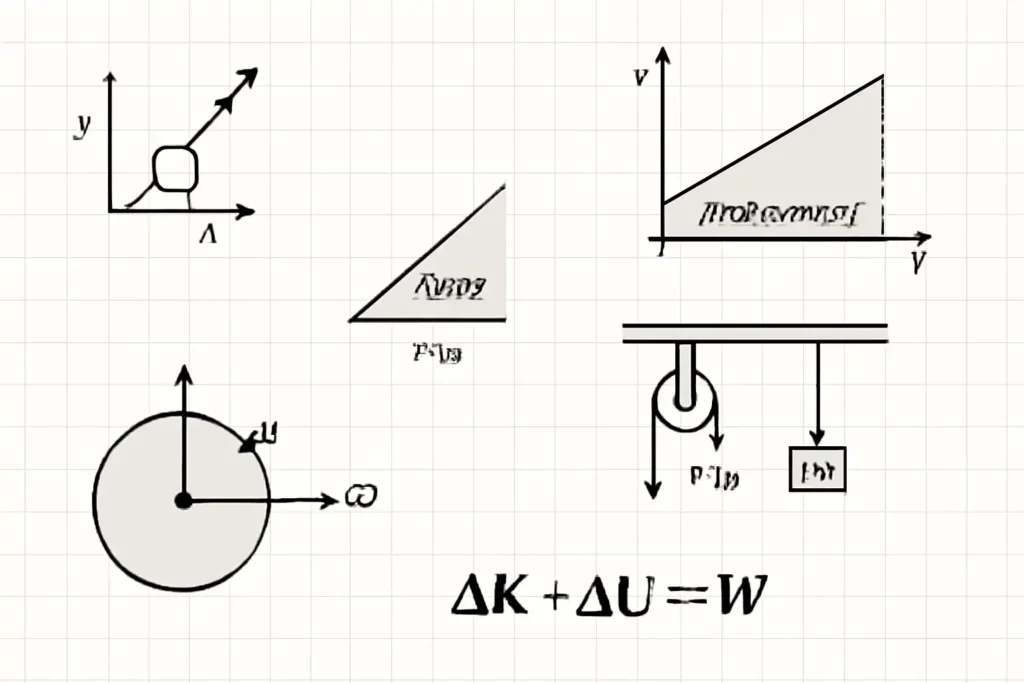
• Use slope for velocity and area for displacement.
• Identify constant acceleration by straight-line graphs.
• Use average velocity methods in uniform acceleration cases.
These small ideas reduce lengthy steps in common JEE problems.
Work, Energy, and Power
Use the work-energy principle to calculate work done quickly. Instead of calculating each step in a force diagram, focus on using energy conservation for a faster solution.
Shortcut idea:
• Replace long force calculations with energy balance.
• Use the work-energy theorem when forces seem complicated.
• Use power formulas to calculate work without integration.
These steps save valuable time during application-based questions.
Rotational Motion
In rotational motion, remember that angular velocity and angular acceleration are directly related to linear motion. This simple concept enables you to quickly convert between linear and angular quantities.
Shortcut idea:
• Use the parallel axis theorem directly.
• Identify symmetry to simplify the moment of inertia.
• Remember standard inertia values to avoid memorisation overload.
These methods improve accuracy and reduce unnecessary steps.
Electrodynamics: Speeding Up Problem Solving
Electrodynamics includes electricity, magnetism, and charge interaction. Many questions become simple with pattern-based thinking.
Electrostatics
Use Gauss’s Law to calculate electric fields instead of using Coulomb’s law directly. Gauss’s Law works particularly well in symmetrical situations, reducing the complexity of problems.
Shortcut ideas:
• Use symmetry for electric field direction.
• Halve the distance to double the force without derivation.
• Identify equal charge distribution in symmetric setups.
These shortcuts support Physics problem-solving shortcuts used in exams.
Current Electricity
For circuit problems, use Kirchhoff’s Law to simplify multiple loops in a circuit. This avoids time-consuming step-by-step calculations, making the analysis quicker and more accurate.
Shortcut ideas:
• Series-parallel recognition patterns.
• Potential divider formulas.
• Current mirror logic in balanced bridges.
These patterns reduce repetitive calculations.
Magnetic Effects of Current
Magnetic force problems can be tricky, but Ampere’s Law helps in calculating magnetic fields quickly in certain symmetrical situations.
Shortcut ideas:
• Use the right-hand rule for direction without memorisation.
• Use field proportionality for quick magnitude checks.
• Identify symmetry for magnetic field cancellation.
These help students solve quickly with confidence.
Optics and Modern Physics: Quick Solutions
Optics has many shortcuts that students can learn with a simple understanding.
Ray Optics Tricks
For ray optics, memorise key formulas for the mirror and lens equations. Quick application of these formulas can help you solve problems in seconds.
• Use straight-line ray diagrams for mirrors and lenses.
• Use focal point shortcuts to find image location faster.
• Use sign convention patterns to avoid confusion.
These steps make image formation questions easier to answer.
Wave Optics
In wave optics, use Young’s Double Slit Experiment formula to solve diffraction and interference problems quickly.
Understanding the basic concepts of path difference and phase difference can speed up the process.
• Use the fringe spacing formula directly in the interference.
• Recognise phase shift patterns in diffraction.
• Use simple ratio logic for fringe movement.
Wave questions become faster and clearer.
Modern Physics
For quantum mechanics, utilise Planck’s constant and the photoelectric equation to solve problems related to energy and frequency quickly. These formulas often appear in questions related to quantum theory.
Modern Physics is full of predictable patterns.
• Use decay shortcuts for half-life calculations.
• Use Einstein’s equation shortcuts for the photoelectric effect.
• Use direct formula recognition for energy questions.
These support Quick JEE Physics solutions during revision.
Join Study with IB, where IB Sir, a JEE physics tutor in Kolkata, will make you understand the basic shortcuts required to score well.
Thermodynamics and Fluid Mechanics: Efficient Problem Solving
Thermodynamics and fluids can seem heavy due to their complex derivations. Shortcuts help simplify the approach.
Laws of Thermodynamics
Use the First and Second Laws of Thermodynamics to simplify problems involving heat exchange and efficiency. This helps you calculate the work done in thermodynamic cycles efficiently.
• Use PV diagram shortcuts for work done.
• Use identity recognition for heat transfer problems.
• Use simple ratios for adiabatic and isothermal comparisons.
These save time in multi-step problems.
Fluid Mechanics
In Fluid Mechanics, the Bernoulli’s equation is essential for solving problems related to pressure and velocity. Mastering this equation makes fluid problems much easier to solve.
• Use continuity equation shortcuts for flow changes.
• Use direct pressure-depth relation for liquid problems.
• Use ratio methods for buoyancy and Archimedes’ force.
These quick patterns improve speed.
Tips for Applying Shortcuts Effectively in Exams
Shortcuts work best when used with strong concepts. Students must practice regularly.
Important Tips:
1. Understand the Concept First
Shortcuts are most effective when you fully understand the underlying concept.
2. Practice Regularly
The more you practice, the faster and more accurately you’ll apply the shortcuts.
3. Stay Organised
During the exam, stay organised and systematic to avoid errors while using shortcuts.
4. Time Management
Prioritise easier problems first, saving the more challenging ones for later, when you have more time.
Mastering Physics with Smart Techniques
Mastering JEE physics preparation hacks and applying time-saving methods can make a significant difference in your performance. Physics might seem daunting at first, but with the right shortcuts and techniques, it becomes a manageable and even enjoyable subject.
The more you practice, the better you will get at recognising which shortcuts to use and when. Remember, consistent practice combined with smart problem-solving techniques is the key to success.
Ready to boost your JEE Physics preparation? Get personalised coaching from IB Sir, JEE physics tutor in Kolkata at Study with IB.
People Also Ask (FAQs)
1. How can speed improve in JEE Physics?
Speed improves through strong concepts, practice, and consistent use of shortcuts.
2. Are shortcuts useful for difficult JEE Physics questions?
Shortcuts reduce the number of calculation steps and simplify complex numerical problems.
3. Which formulas are essential for JEE Physics?
Kinematics, energy, electrostatics, and optics formulas boost performance.
4. How can shortcuts be used without mistakes?
Shortcuts are most effective when mastered through regular practice of concepts.