Have you ever spent hours staring at a Physics problem, feeling like you’re hitting a brick wall?
Many students lose their confidence because they try to “mug up” equations instead of seeing how they actually work in real life.
The truth is, every brain processes information differently. While one student might understand a concept through a book, another might need to see a 3D animation of a rotating object to finally “get it.”
Custom Learning to Master Physics
Rather than relying on one-size-fits-all methods, we focus on personalised teaching strategies. These strategies, guided by expert mentors like IB Sir at Study with IB, can help unlock your full potential.
In this blog, we’ll explore how personalised Physics coaching can address each student’s unique learning needs.
What does personalised Physics coaching mean?
Personalised = pace + explanation style + practice plan + review loop
Personalised Physics coaching is a customised learning approach where teaching is aligned with a student’s individual pace, understanding level, and exam goals. It adapts explanation methods, practice patterns, and revision strategies based on specific strengths and weak areas.
Why does Physics feel easy for some students and impossible for others?
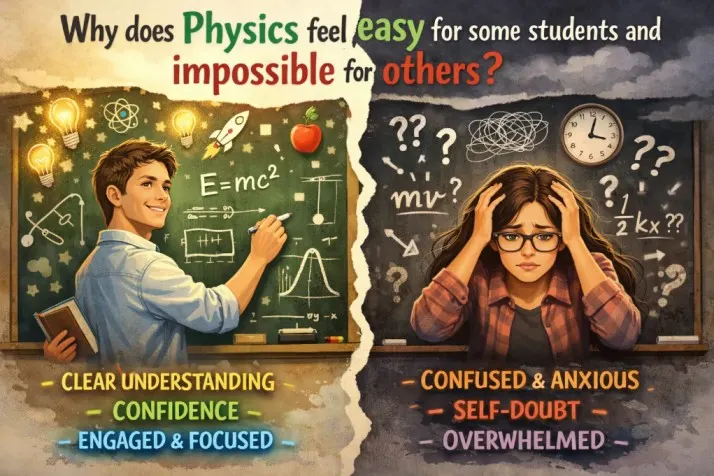
Different brains, different “default settings.”
Physics is often treated like a race where everyone starts at the same line, but in reality, every student is running on a different track.
Some students are natural visual thinkers; they can see a pulley system moving in their mind’s eye. Others have a high mathematical speed but struggle with the theoretical “why” behind a derivation.
There is also the factor of exam anxiety, students who know the concepts perfectly but freeze the moment they see a JEE question paper. These “default settings” determine how a student absorbs information.
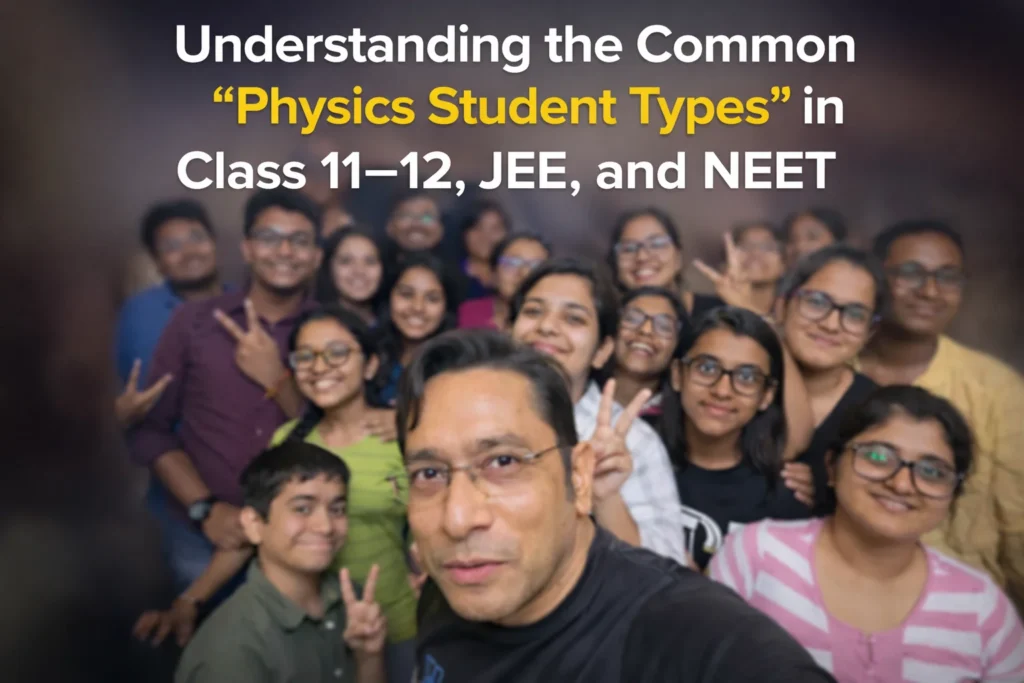
What are the most common “Physics student types” in Class 11–12, JEE & NEET?
| Student Profile | Description |
| The “Concept Samajh Aata Hai, Numericals Nahin Hote” student | These students can explain the theory perfectly, but as soon as a numerical appears, they don’t know which formula to apply or how to start the calculation. |
| The “Backlog Monster” student | Students often get overwhelmed by the jump in difficulty from Class 10. Once they fall behind by two chapters, they feel it’s impossible to catch up, leading to a “monster” of unread topics. |
| The “Silly Mistakes” student | Brilliant students who lose 10-15 marks per test due to unit conversion errors, calculation slips, or misreading the question. They need a strategy, not more theory. |
| The “Fear & Freeze” student | These students perform well at home but struggle under the pressure of a ticking clock. They need a JEE/NEET physics test series and performance analysis to gradually build mental stamina. |
| The “Topper Stuck at a Plateau” student | These students are already scoring 80%, but they can’t break into the 95%+ bracket. They don’t need basic lectures; they need high-level problem-solving tweaks, which can only be provided by an expert one-to-one physics tutor in Kolkata. |
Every student has their own learning hurdles, and recognising them is the way to improvement.
This step-by-step approach ensures a clear path forward for every student.
Step 1: How a good teacher helps you with the exact problem first
Before fixing your marks, a good teacher fixes the approach.
Most students think they are “bad at Physics,” but that’s rarely the case. They are often weak in a specific area of Physics that has not been properly identified.
Mentors like IB Sir, the best physics teacher in Kolkata, take the time to understand your exact problem instead of rushing through more chapters. This personalised approach ensures that you learn effectively and at your own pace.
Baseline test
The first step a good teacher takes is a smart baseline test, not a random paper or a full syllabus panic test.
The goal is to find out whether you have a concept gap (struggling with understanding basic concepts) or an application gap (understanding the theory but not knowing how to solve problems).
Chapter mapping
Physics is a layered subject. Weakness in one chapter can lead to struggles in others. For example:
- Weak in Vectors? Mechanics suffer.
- Weak in NLM? Rotational Mechanics collapses.
- Weak in Current Electricity? Circuits become overwhelming.
A good teacher will map your performance chapter by chapter and pinpoint the “foundation leaks.”
Instead of overwhelming you with the entire syllabus, they focus on fixing the most critical weak areas first, ensuring that you build a solid foundation for more complex topics.
Mistake tracking
In physics doubt-clearing classes, mistakes are tracked systematically. Every test is analysed for patterns to identify recurring errors. Whether it’s calculation errors or conceptual confusion, the teacher will adapt their teaching approach based on your mistakes.
This pattern-based correction helps you focus on areas that need the most attention, allowing you to improve your performance faster.
Step 2 — How your learning plan gets customised
Once the issues are diagnosed, it’s time to personalise your learning plan. This is where the magic happens, as the learning experience shifts from a generic approach to a personalised plan tailored to you.
Building the “physics language” first
If you are struggling with the basics, the teacher starts by helping you build a strong foundation. You need to understand key terms like velocity, acceleration, and force before tackling complex problems.
Once the basics are in place, the teacher moves on to advanced concepts, which you’ll be better equipped to understand.
Strengthening problem approaches and speed
For students who understand the concepts but struggle with application, the focus is on improving problem-solving techniques and speed. With practice, you’ll become faster and more accurate, which is crucial for exams like JEE and NEET.
Advanced patterns and multi-concept questions
For those who already grasp the fundamentals and need more challenges, the teacher will focus on advanced problem-solving. These problems often involve multiple concepts, sharpening your analytical skills, and preparing you for the toughest exams.
Step 3 — Teaching methods that actually help different learners
Not everyone learns the same way, and a good teacher knows how to adapt their methods.
Visual learners: diagrams, 2D/3D models, graphs, simulations
Visual learners benefit from diagrams, 2D/3D models, and simulations that bring abstract Physics concepts to life. These tools make topics like mechanics, electromagnetism, and optics much easier to understand.
Once concepts are visualised, the next focus is speed and accuracy in solving problems.
Slow-to-start learners: step ladders
For students who take longer to understand, a step-by-step approach is used. Starting with easy problems, the teacher gradually increases difficulty, building confidence before moving to more challenging problems.
Fast learners: challenge sets and time-bound drills
For fast learners, the teacher provides challenge sets and time-bound drills to push them further. These exercises help them solve complex problems under pressure, preparing them for competitive exams like JEE and NEET.
Step 4 — Doubt clearing that doesn’t waste your whole week
In large classes, doubts often pile up, wasting valuable time. A good teacher addresses doubts quickly, ensuring that no question goes unresolved for too long.
The “24–48 hour doubt rule”
Doubts should be cleared within 24–48 hours, not left hanging. This fast resolution ensures that students stay on track and continue their learning without setbacks.
Different Student, Different Learning Approach
A personalised learning approach helps students better understand their challenges and strengths. With expert guidance from IB Sir, the best physics teacher in Kolkata, students gain a clear understanding of their unique learning needs.
Don’t let challenges hold you back. Contact Study with IB, the coaching centre of IB Sir, for one-on-one coaching that’s personalised to your needs.
Call +91 9474114212 for admission-related queries.
People Also Ask (FAQs)
- Is personalised coaching better than coaching at big institutes?
Personalised coaching is better for students who need targeted support and faster results.
- How many tests should a JEE/NEET student take per month?
4-6 tests per month, with detailed analysis, is ideal for steady progress.
- What if my Class 11 backlog is huge—can I still recover?
Yes, with targeted support and focused revisions, you can recover and perform well.
- How do I stop silly mistakes in Physics numericals?
Maintain an error log, focus on units, and double-check every step to eliminate careless errors.
- Is 1:1 Physics tuition worth it in Class 12?
Yes, for students aiming for top ranks, 1:1 tuition provides a tailored learning experience.