
The concept can turn a simple concept of physics into pages of dense explanation, yet the concept still feels distant. A teacher changes it by helping you understand the idea rather than just reading it.
Let’s understand this with an example: When they shine a laser through a glass block, and you watch the beam bend, the entire chapter on refraction suddenly makes sense. That one visual moment does what long descriptions can’t.
This blog explains that different visual-learning methods enable teachers to simplify complex, abstract physics concepts.
The Importance of Visual Learning in Physics
Physics involves many concepts, such as forces, fields, currents, and energy changes, that students often do not understand properly. Visual learning solves this by connecting theory with real-world representation.
Teachers use physics visual aids, such as diagrams, animations, and demonstrations, to help students understand better. This strengthens memory, improves retention, and supports clearer conceptual teaching.
So take a look at the methods IB Sir uses to help students understand Physics better.
Diagrams and Charts
Diagrams
- It simplifies heavy theory by turning ideas into visuals.
- They reduce confusion and make teaching abstract physics concepts far easier.
Charts
- It displays data visually so students can compare values, spot trends, or understand how one physical quantity affects another.
- Motion graphs, energy charts, and temperature-time curves make lessons more intuitive and support conceptual physics teaching.
Together, diagrams and charts are powerful visual aids for physics that make learning less text-heavy and more student-friendly.
Interactive Simulations
Interactive simulations allow students to change values, observe results, and repeat virtual experiments — something traditional classrooms cannot always offer. These digital tools show real-time behaviour of waves, forces, and motion, making lessons far more engaging.
IB sir, use these simulations to demonstrate concepts step-by-step, guide students through experiments, and explain why the results change when certain variables are adjusted.
Simulations are especially helpful for:
- Wave patterns and interference
Wave simulations show how ripples move, overlap, and create bright–dark patterns. Students can see constructive and destructive interference instead of only memorising definitions.
- Electromagnetic field interactions
Visual tools display electric and magnetic field lines in motion, helping students understand how charges and magnets influence each other — something impossible to observe with the naked eye.
- Projectile trajectories
Simulations graph the curved path of a moving object in real time. Students can change angle, speed, or height to see how these factors affect motion instantly.
- Energy transformations
Interactive visuals show energy changing from one form to another — like potential turning into kinetic. This helps students connect formulas with real physical behaviour.
These tools create a dynamic environment for interactive physics teaching, allowing students to experiment safely and see outcomes instantly. Simulations are becoming a core part of modern physics education methods because they deepen understanding through exploration.
Physical Models
Physical models make invisible concepts feel real. They allow students to touch, rotate, and examine structures that they normally only read about. This tactile experience helps students mentally visualise ideas, improving clarity and memory.
Physical models are especially valuable for:
- Electric circuits (current flow and components)
- Galaxy and orbital motion (planetary paths and rotations)
- Optical lenses (convergence, divergence, focal points)
- Molecular structures (spatial arrangement of atoms)
These three-dimensional tools remain some of the most effective tools for teaching physics. Models give students a concrete way to understand abstract physics concepts that are otherwise difficult to imagine.
To experience this hands-on learning, join Study with IB, where IB Sir, thebest physics teacher in Kolkata, will enhance your understanding.
Effective Visual Aids for Teaching Physics
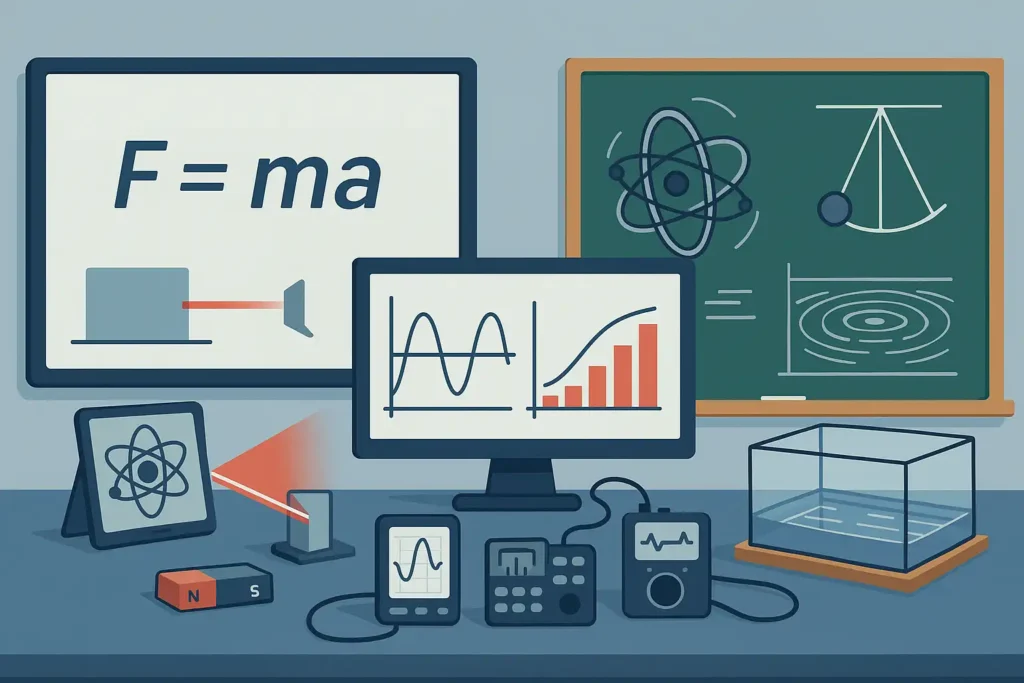
Visual tools reduce confusion and strengthen conceptual understanding. IB Sir use a balanced set of traditional and digital aids to support learning.
Incorporating Technology in Physics Lessons
Modern classrooms use a range of tools and the latest technology to teach physics:
- Smartboards
- Augmented reality (AR)
- Virtual labs
- Motion detectors
- Sensors and graphing tools
Technology transforms theory into moving, interactive visuals that students can follow with ease.
Hands-on Experiments and Demonstrations
Demonstrations remain one of the strongest methods because students learn best by observing real behaviour.
Examples:
- A laser is used to bend glass to explain refraction
- A magnet induces a current to show electromagnetic induction
- A pendulum demonstrating periodic motion
- Ripple tanks visualising wave patterns
These small classroom moments often create lifelong conceptual clarity.
Collaborative Learning and Peer Teaching
Group tasks such as model-building, diagram solving, and simulation-based activities encourage students to learn visually from one another.
Peer explanations simplify tough concepts and strengthen retention.
Strategies for Implementing Visual Learning in the Classroom
Effective physics classroom strategies include:
• Starting each abstract concept with a visual hook
• Using a mix of diagrams, models, and simulations
• Allowing students to experiment through virtual labs
• Encouraging them to draw their own diagrams
• Integrating videos and animations for difficult topics
• Linking every formula to a real-life visual example
Benefits of Visual Learning for Students
Visual learning sharpens understanding and makes physics approachable.
Enhanced Understanding and Retention
Students remember visuals longer than text. Clear mental pictures help them recall concepts during exams and real-world applications.
Increased Engagement and Motivation
Visual content feels interactive and exciting. Students stay attentive because they can see physics in action.
Development of Critical Thinking Skills
Visual tools encourage students to explore patterns, identify relationships, and solve problems analytically — improving critical thinking.
Case Studies
Successful Implementation of Visual Learning in Physics
Below is a table summarising real examples of successful visual-learning practices in physics classrooms.
Examples of Visual Learning in Physics
| Optics Lesson | Laser + glass block | Students instantly understood refraction |
| Circuits | LED circuit boards | Improved grasp of current flow and resistance |
| Waves | Ripple tank | Students clearly visualised frequency, amplitude, and interference |
| Projectile Motion | Motion sensor & graphing tool | Better understanding of time-position relationships |
| Astronomy | 3D planetary models | Increased spatial understanding of orbits |
These examples show how integrating physics visual aids transforms difficult lessons into clear, engaging experiences.
The Future of Visual Learning in Physics Education
The future of physics teaching lies in making learning clearer, more interactive, and deeply engaging. With stronger visuals, digital tools, simulations, and models, classrooms are moving beyond rote memorisation toward true understanding. As technology evolves, visual learning in physics will evolve as well, giving teachers more power to simplify complex ideas.
Contact IB Sir, one of the best physics teachers in Kolkata, at Study with IB. Call +91 9474114212 today.
People Also Ask (FAQs)
1. Why is visual learning important in physics?
Visual learning in physics involves invisible processes; visuals help students see and understand concepts better than text alone.
2. How do teachers make abstract physics concepts easier?
By using diagrams, simulations, models, and hands-on demonstrations that turn theory into visible, relatable events.
3. What visual tools help in teaching physics effectively?
Simulations, animations, AR tools, charts, 3D models, smartboards, and lab demonstrations.
4. Does visual learning improve exam performance in physics?
Yes. Students with strong visual understanding recall concepts more easily and solve problems confidently.