

Engineering dreams in India often begin with curiosity about how machines work, how bridges stand, and how technology solves problems. But somewhere between Class XI and competitive exams, many students hit a wall called physics.
Marks fluctuate. Confidence drops. Parents wonder if engineering is still the right path.
This blog breaks the noise. It explains why physics is the backbone of engineering, how it shapes thinking beyond marks, and what students must do to master it calmly and confidently.
Why Does Physics Matter So Much for Engineering?
Engineering is applied physics. If the foundation is weak, everything built on it feels unstable.
Physics is not just another subject in the syllabus. It trains the brain to analyse, apply logic, and solve real-world problems, the exact skills engineers use every day.
Mastering the JEE Main 2026 Physics syllabus builds the foundation for both exams and real-world engineering thinking.
Physics Builds Problem-Solving Skills
Students already solve problems daily, planning exam schedules, fixing gadgets, and choosing faster routes. Physics simply formalises this thinking.
When a student faces a physics problem, they are not just hunting for an answer. They are learning to:
- Understand a situation before reacting
- Identify relevant information
- Break complex systems into simpler parts
- Reach conclusions step by step
This mirrors how engineers work in the real world. Engineers do not guess. They analyse, test assumptions, and refine solutions logically.
Real-Life Impact on Students
As physics thinking improves, students notice changes that go beyond marks:
- Exams feel less intimidating
- Unexpected questions feel manageable
- Confidence grows across subjects
Before we look at data, here’s what physics actually trains in students—and how it helps outside exams.
| Skill Learned in Physics | Real-World Benefit |
| Logical breakdown | Clear thinking under pressure |
| Step-wise reasoning | Fewer careless mistakes |
| Scenario analysis | Better adaptability |
Engineering Concepts Are Rooted in Physics
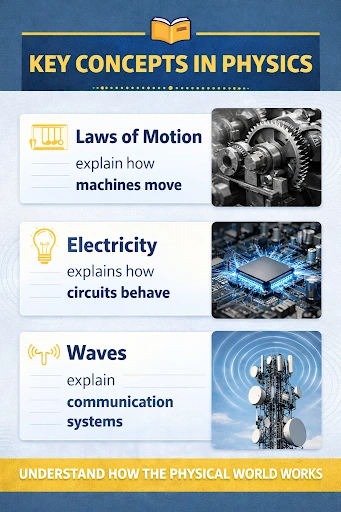
Here’s an often-missed truth: engineering is not separate from physics—it is built on it.
Before students encounter subjects like machine design, circuit theory, or signal processing, they already meet these ideas in physics classrooms. When physics concepts are clear, engineering subjects later feel familiar instead of overwhelming.
For example:
- Laws of motion explain how machines move
- Electricity explains how circuits behave
- Waves explain communication systems
Students who understand why things happen in physics rarely struggle with how to apply them in engineering.
The table below shows how core physics concepts directly map to engineering disciplines.
| Physics Concept | Engineering Connection |
| Laws of motion | Mechanical systems |
| Current electricity | Electrical circuits |
| Wave behaviour | Communication engineering |
What Skills Does Every Engineering Aspirant Need?
Engineering aspirants need strong conceptual clarity and disciplined numerical thinking. One without the other is incomplete.
Performance in Physics becomes stable only when understanding and accuracy grow together.
Conceptual Understanding
Many students believe they understand physics because they remember formulas. But real understanding means knowing when, why, and how to use them.
Conceptual clarity allows students to:
- Visualise problems instead of memorising steps
- Predict outcomes logically
- Handle variations confidently
Parents often observe a clear shift once concepts click, study hours reduce, and results improve naturally.
Here’s how learning style directly affects performance
| Learning Approach | Outcome |
| Formula memorisation | Unstable performance |
| Concept-based learning | Consistent improvement |
Numerical Accuracy and Logical Thinking
Physics numericals are not designed to scare students. They test clarity under pressure.
Engineering exams reward students who can:
- Maintain accuracy within time limits
- Track units and signs carefully
- Think logically instead of rushing
Strong numerical habits convert fear into confidence
| Numerical Skill | Practical Advantage |
| Unit consistency | Fewer errors |
| Step clarity | Partial marks protection |
| Estimation | Faster MCQ elimination |
How Does Physics Apply Across Engineering Branches?
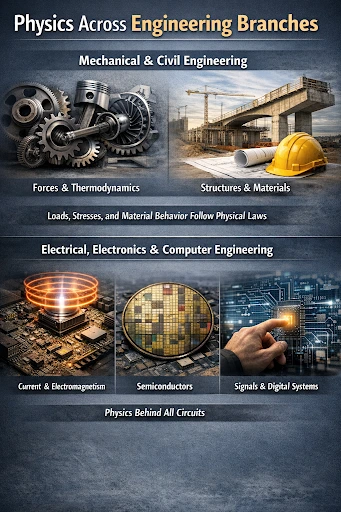
Physics adapts to every engineering branch. The application changes, but the foundation remains the same.
Let’s break this down branch-wise:
Physics for Mechanical and Civil Engineering
Mechanical and civil engineering deal with forces, structures, materials, and energy, pure physics in action.
Students who struggle with physics often find these branches overwhelming later because:
- Loads, stresses, and motion are physics concepts
- Material behaviour follows physical laws
When physics is strong, these subjects feel logical rather than abstract.
| Branch | Physics Foundation |
| Mechanical | Mechanics, thermodynamics |
| Civil | Statics, material physics |
Physics for Electrical, Electronics, and Computer Engineering
Even students inclined toward coding or electronics cannot bypass physics early on.
Physics explains:
- Why current flows
- How semiconductors behave
- How signals travel and weaken
Without clarity, students end up memorising circuits instead of understanding them.
| Branch | Physics Dependency |
| Electrical | Electromagnetism |
| Electronics | Solid-state physics |
| Computer | Digital electronics |
Why Is Physics Crucial in Engineering Entrance Exams?
Physics often determines ranks based on its weightage and conceptual depth. Despite contributing one-third of the marks, it has the lowest score. Understanding the modern Physics weightage in JEE Main helps students focus on scoring, predictable topics, improving accuracy, saving time, and boosting their overall rank effectively.
Here’s an important awareness point for students and parents:
Physics contributes roughly one-third of total marks in major engineering entrance exams, yet records the lowest national average scores, making it the biggest rank differentiator.
How Physics Scores Affect Overall Rank
A strong physics score can compensate for average performance elsewhere. This is why toppers prioritise physics early.
| Physics Performance | Rank Outcome |
| Weak | Rank drops significantly |
| Average | Borderline cut-offs |
| Strong | Sharp rank improvement |
Why Do Students Struggle With Physics?
Physics feels difficult when it is taught as information instead of understanding. Before blaming the difficulty, it’s crucial to identify how students are learning.
Rote Learning Instead of Understanding
Rote learning creates fragile confidence. Even a small change in question pattern leads to panic.
Students often experience:
- Formula confusion
- Fear during exams
- Self-doubt
| Learning Style | Result |
| Rote learning | Inconsistent marks |
| Conceptual learning | Calm reasoning |
Fear of Numericals
Fear rarely comes from complexity. It comes from weak fundamentals. When basics are clear, numbers turn into logical puzzles.
How Can Students Build a Strong Physics Foundation?
Building a strong foundation in physics requires consistent practice and a solid understanding of important concepts.
With structured lessons and experienced tutors, students can strengthen their grasp of challenging topics and gain confidence in their abilities, laying a solid foundation for future learning.
To excel in physics, students need a solid grasp of core concepts. Study with IB, a Physics coaching in Kolkata, IB Sir provides expert guidance, helping students improve problem-solving skills and ace their exams.
Start Early With Basics
Physics understanding compounds over time. Starting early reduces last-minute stress and builds confidence gradually.
| Start Time | Result |
| Early preparation | Comfort and clarity |
| Late preparation | Pressure and confusion |
Practice, Revision, and Testing
Physics improves through feedback. Practice without reflection doesn’t help.
Effective learning includes:
- Concept-based practice
- Regular testing
- Error analysis
| Method | Benefit |
| Timed tests | Exam readiness |
| Revision cycles | Long-term recall |
| Error tracking | Stable scores |
How Physics Shapes Engineering Thinking Beyond Exams
The importance of physics for engineering lies in developing logical thinking, problem-solving ability, and exam confidence. From entrance exams to engineering careers, physics remains the most reliable indicator of long-term academic success when learned conceptually.
Contact Study with IB for physics coaching in Kolkata today. Call at + 91 9474114212 today.
People Also Ask
- Why is physics important for engineering students?
Physics builds analytical thinking and problem-solving skills that engineers rely on throughout their careers.
- How much physics is required for engineering entrance exams?
Physics accounts for about one-third of the total marks and strongly influences rank outcomes.
- Is physics harder than chemistry for JEE?
Physics requires deeper conceptual understanding, which can feel harder for students who rely on memorisation.
- How should students prepare for physics for engineering exams?
Students should focus on concept clarity, structured practice, and regular testing, not rote learning.