
Let’s move from the weight of endless theory pages to the brilliance of 3D learning.
For years, the biggest hurdle in education has been forcing students to memorise complex formulas simply because they cannot see the physical forces in action.
This blog will help you understand how Augmented Reality (AR) changes this by turning abstract concepts like Electrostatics into interactive 3D visuals. This technology bridges the gap between theory and reality, making complex topics feel like a lived experience.
What is Augmented Reality (AR) in Physics?
Turn complex theories into hands-on experiences, making abstract concepts understandable and connecting.
Augmented Reality (AR) is transforming learning Physics by merging real-world environments with interactive 3D simulations.
Students can visualise and engage with complex concepts such as forces, waves, and atomic structures in real time, turning abstract theories into tangible experiences. This immersive, multi-sensory learning approach enhances understanding and makes physics more engaging.
It allows learners to actively interact with the material, rather than just study it. AR is bringing physics to life in ways traditional methods never could.
AR vs VR vs XR in Physics Coaching: Which Technology Works Best for Students?
When it comes to immersive learning experiences for physics, each technology, AR, VR, and XR, offers different benefits.
| Technology | Augmented Reality (AR) | Virtual Reality (VR) | Extended Reality (XR) |
| About | Overlays digital content on the real world, enhancing the physical environment. | Immerses users in a completely virtual world, disconnecting from the real world. | Combines both AR and VR, providing a hybrid experience. |
| Interaction with Reality | Blends digital elements with the real world, allowing students to interact with both. | Fully immerses students in a virtual world, with no physical world interaction. | Blends both virtual and real worlds, offering a broader experience. |
| Hardware Requirements | Works with smartphones, tablets, and smart glasses. | Requires VR headsets and more specialised hardware. | Requires both AR and VR hardware, making it less accessible. |
| Learning Experience | Offers a more interactive and practical learning experience, allowing students to manipulate real-world and digital physics concepts. | Provides full immersion into simulated physics environments, but lacks real-world interaction. | Provides a mixed experience, but can be complex and less focused. |
| Practicality for Physics Coaching | Ideal for visualising physics concepts like motion, forces, and energy in the real world, making learning more relatable. | Great for visualising complex physics scenarios, but limits real-world application. | Can be used for broader experiences but may overwhelm students in a physics context. |
Where AR Fits Perfectly in Physics
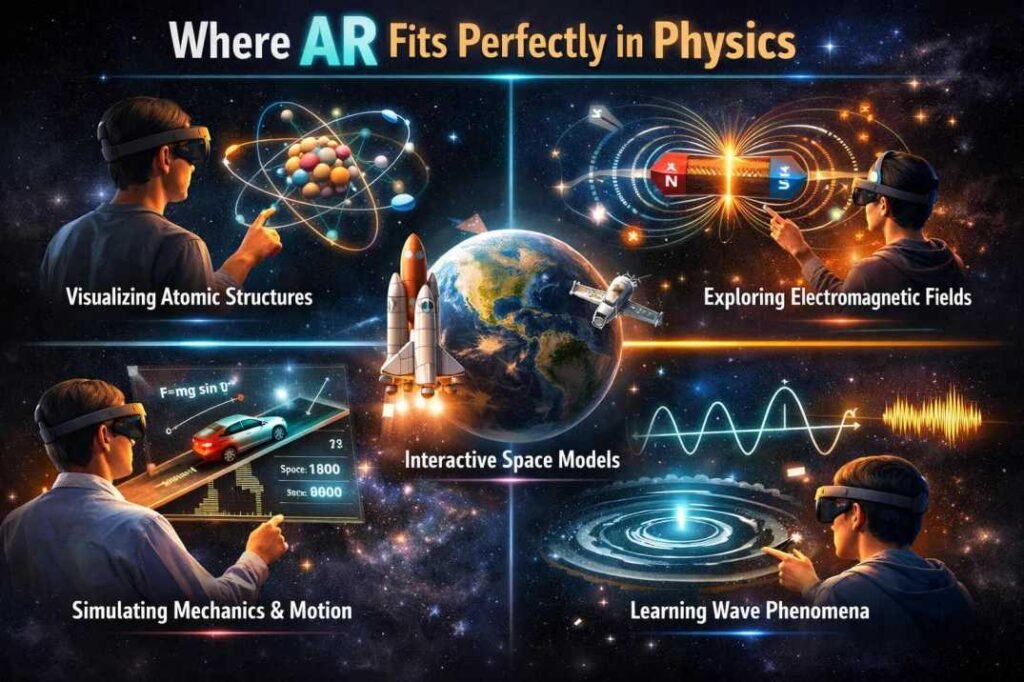
Just think about this scenario of pointing your phone at a drawing of a circuit in your book. Suddenly, through your screen, you see blue glowing electrons actually flowing through the wires. You can tap a switch on your screen and watch the lightbulb glow. That is the power of AR-integrated learning.
Let’s know in what concepts and theories of Physics it can be used:
Mechanics: Vectors, Projectile Motion, Circular Motion in 3D
You are trying to understand projectile motion through flat diagrams or static images. AR transforms this by projecting a real-world environment where students can manipulate objects and visualise the path of a ball or an arrow in 3D. They can alter the angles and velocity and observe how these changes affect the motion in real-time.
This hands-on interaction allows students to better grasp the complexities of vectors, projectile motion, and circular motion, making abstract concepts much more tangible and engaging.
Optics: Ray Diagrams You Can Rotate and “Walk Around”
In traditional learning, ray diagrams are static and difficult to understand in two dimensions. AR in physics learning can help students visualise how light travels and bends through different media. With AR apps, students can rotate ray diagrams and move around them to see how light behaves in 3D.
Electricity & Magnetism: Fields, Right-Hand Rule, Circuits
AR makes electricity and magnetism interactive. Students can use AR to visualise electric fields and apply the right-hand rule by using simple gestures to see the direction of magnetic forces or current flow in 3D.
Modern Physics: Atomic Models and Visualisation-Friendly Concepts
The atomic model is another abstract concept that benefits greatly from AR. Students can explore and interact with atomic structures, observe quantum effects, and understand concepts like wave-particle duality with clear, visual demonstrations.
At Study with IB, we integrate this cutting-edge technology into our physics coaching in Kolkata, offering students a truly immersive learning experience.
7 Practical Ways Physics Coaching Can Use AR

| Case | Purpose | How AR Helps | Benefit |
| Pre-Class Concept Demo (30 Seconds to Hook Attention) | Quickly engage students before the lesson begins. | A quick AR demo shows how atoms and subatomic particles behave, sparking curiosity right at the start. | Instantly grabs attention and sets the stage for deeper exploration. |
| Live Doubt-Clearing with Interactive 3D Overlays | Solve student doubts in an interactive way. | Students interact with 3D models on phones/tablets to visualise the problem they’re struggling with. | Real-time interaction enhances understanding and effective problem-solving. |
| “Virtual Lab” Moments When Real Labs Aren’t Possible | Provide hands-on learning when physical labs aren’t available. | AR simulates physics experiments (like optics), allowing students to experiment with light and materials. | Immersive, lab-based learning without needing a physical lab. |
| Error-Spotting: Show Common Misconceptions Visually | Help students identify and correct misconceptions. | AR visually demonstrates current flow in electrical circuits to pinpoint where the student’s understanding is wrong. | Immediate feedback helps correct mistakes and deepens understanding. |
| Problem-Solving: Turning Word Problems into AR Scenes | Make word problems easier to understand. | AR transforms word problems (e.g., projectile motion) into 3D scenes, visualising the object’s path in real-time. | Helps students grasp complex concepts and solve problems effectively. |
| Revision Sprint: AR Flash-Recaps for Formulas + Concepts | Make revision interactive and engaging. | Students use AR flashcards to review important formulas and concepts quickly. | Reinforces learning in a time-efficient, engaging way, especially for exams. |
| Test Strategy: Visual Intuition → Faster Elimination in MCQs | Improve speed and accuracy in exams. | AR visualises key concepts, helping students eliminate incorrect MCQ options quickly using visual intuition. | Boosts exam efficiency and helps focus on the right answers faster. |
The Impact of Augmented Reality on Physics Learning and Coaching
Augmented Reality (AR) is revolutionising education by making complex concepts like mechanics, optics, and electricity more interactive and visual. AR enhances learning with 3D visualisations, virtual labs, and real-time simulations, improving concept clarity and retention. It is especially beneficial for JEE/NEET physics preparation. However, it requires access to devices, the internet, and teacher training.
Ready to experience immersive physics learning with AR? Join study with IB for physics coaching in Kolkata today.
Call +91 9474114212 for admission-related queries.
People Also Ask (FAQs)
- Is AR useful for JEE Physics preparation?
Yes, AR can be extremely helpful for JEE physics visual learning, especially for understanding complex concepts like mechanics, optics, and electricity.
- What is the difference between AR and VR in learning?
While VR immerses you completely in a virtual world, AR enhances the real world with digital elements, making it more practical for subjects like physics.
- Can AR replace a Physics lab?
AR can simulate many lab experiences, making it a valuable tool for students when a virtual physics lab for students is needed.
- Does AR improve concept clarity and memory?
AR has been proven to improve both concept clarity and memory retention by offering interactive and visual learning experiences.
- Is AR learning expensive for students?
While there may be initial costs for devices, AR can ultimately be cost-effective, especially in schools with existing mobile devices.
- What chapters benefit most from AR in Physics?
Chapters like mechanics, optics, and electricity and magnetism benefit the most from AR because they involve complex, abstract concepts.