Physics can quietly pull down your child’s NEET score even when biology feels strong. One weak concept, one slow calculation, or one wrong guess can cost marks that may affect the rank.
However, a professional NEET physics coaching reshapes the way physics is studied. Students learn beyond theory. For physics, students need something sharper: concept clarity, quick thinking, regular practice, and honest mistake correction.
Before diving deep, here’s a quick summary of what's covered in this blog.
At a Glance: Reason Why Most NEET Aspirants Score Poorly in Physics
This blog explains why many aspirants struggle with physics despite regular study. It also shares how NEET physics coaching can identify common mistakes and help with strategies to improve speed, accuracy, and confidence.
Why Physics Becomes the Fear Subject in NEET
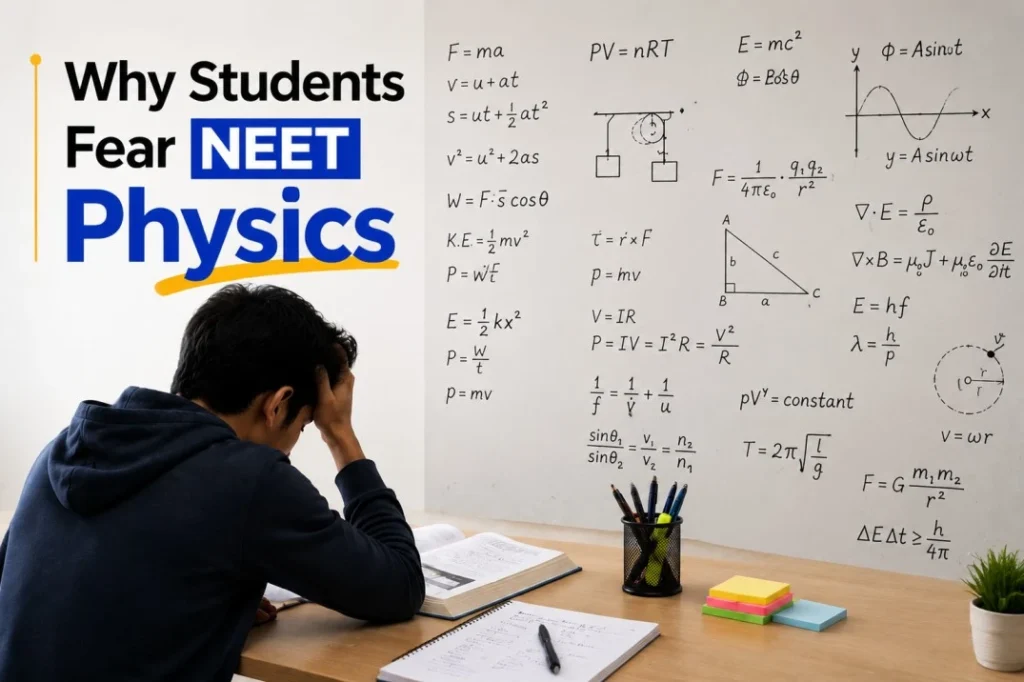
NEET physics feels difficult because it tests application, not just memory. The reasons why NEET physics is so hard are:
- Knowing formulas but unable to apply them
- Taking too long to solve numerical questions
- Small calculation errors
- Avoiding difficult chapters
- Not analysing why answers are wrong.
For example, a question on motion may require an understanding of force, acceleration, graphs, and equations together.
Is Physics Really Harder Than Biology and Chemistry in NEET?
Physics is not necessarily harder than biology or chemistry. It simply requires a different learning approach.
Biology mainly depends on understanding and remembering information. Chemistry requires a mix of concepts, reactions, and calculations. Physics requires applying concepts under time pressure. A formula alone cannot solve a question unless students know:
- What the formula represents
- Where it can be applied
- Which values matter
- What conditions are involved
What Do NEET Toppers Do Differently in Physics?
NEET toppers do not simply solve thousands of questions. They focus on solving the right questions with proper analysis.
They usually follow these habits:
- Concept-building
- Regular formula revision
- Practise previous year questions
- Analyse mistakes after tests
- Calculation speed improvement
- Accuracy building
They do not ignore difficult topics. Instead, they break them into smaller concepts and gradually improve.
This approach is especially useful for chapters where students often struggle while solving tricky topics like Center of Mass and other application-based problems.
What Are the Real Reasons Students Fail NEET Physics?
Here are the common mistakes JEE and NEET aspirants both make in physics.
Reason 1 — Are You Memorising Formulas Without Understanding Them?
Please focus on:
- What the formula explains
- When to use it
- What each value represents
- Which mistakes to avoid
Looking for NEET physics weak concepts and how to fix them? Start by rebuilding the basics instead of jumping directly into difficult questions.
Reason 2 — Skipping Physics Because It “Feels Difficult”?
Instead of avoiding difficult chapters, divide them into smaller targets.
For example:
- Understand one concept
- Solve a few basic questions
- Practise application-based questions
- Review mistakes
Reason 3 — Is Poor Time Management Costing Marks?
To manage time, learn to identify:
- Questions you can solve quickly
- Questions that need more thinking
- Questions better left for later
If your NEET physics score is stuck despite knowing concepts, check whether slow solving is the real issue.
Reason 4 — Making Silly Calculation and Sign Errors?
Common errors include:
- Wrong unit conversion
- Missing negative signs
- Incorrect calculation
- Copying values incorrectly
- Ignoring direction in vectors or circuits
Maintain an error notebook where you record:
- The question
- The mistake made
- The correct method
- How to avoid it next time
Reason 5 — Is Lack of Revision Making You Forget Concepts?
A strong NEET physics revision strategy should include active revision instead of only reading notes.
Try:
- Writing formulas from memory
- Revising important diagrams
- Solving previously incorrect questions
- Taking short concept quizzes
- Reviewing weak chapters regularly
Reason 6 — Avoiding Mock Tests and PYQs?
Mock tests and PYQs show the actual preparation level. A mock test helps students identify:
- Weak chapters
- Calculation problems
- Time management issues
- Repeated mistakes
- Unnecessary guesses
After every test, spend time analysing the mistakes.
Can You Really Fix NEET Physics in Just 30 Days?
Yes, students can improve physics performance in 30 days, but the approach needs to be realistic.
A month is enough to fix weak concepts, improve accuracy, revise important chapters and reduce repeated mistakes. However, it is not enough to study everything from scratch.
If your child has more preparation time, follow our detailed 3-month NEET physics study plan for deeper chapter coverage and a more relaxed practice schedule.
What’s Realistic to Expect in 30 Days vs. What’s Not?
- Strengthen important concepts
- Revise high-return chapters
- Improve numerical speed
- Practise NEET-level questions
- Analyse mock test mistakes
- Reduce negative marking
However, avoid unrealistic expectations like completing every book, mastering every advanced problem or learning the entire syllabus from zero.
What Is the Best 30-Day Plan to Fix NEET Physics?
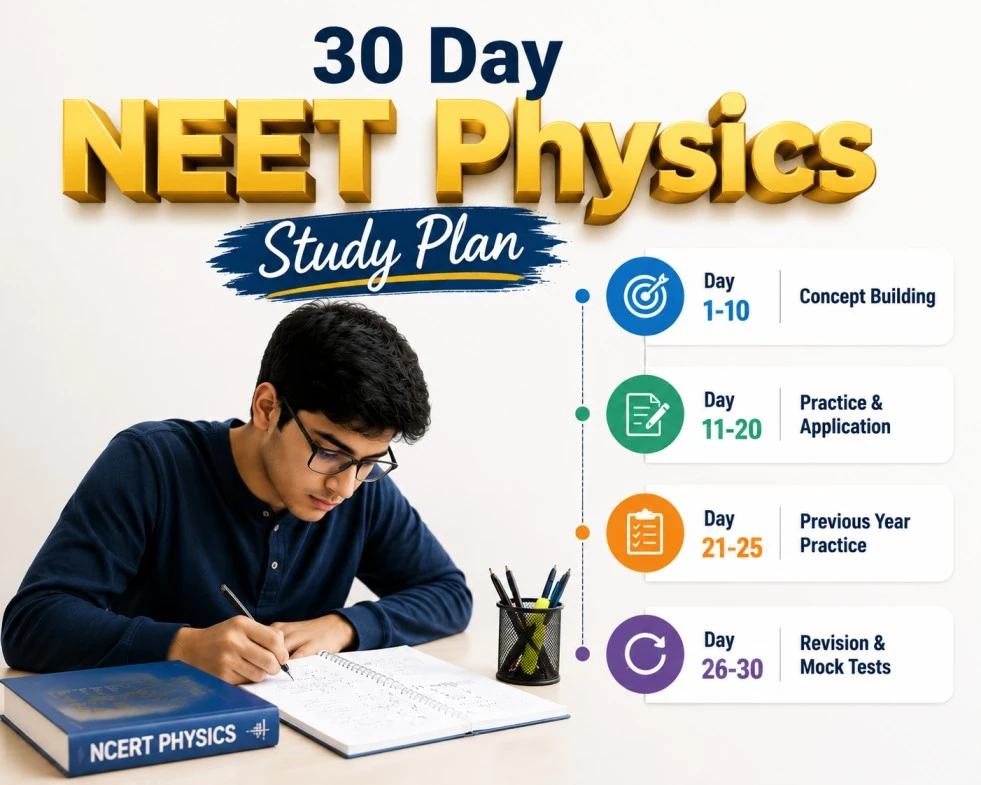
A good NEET Physics preparation in 30 days plan should have four stages: rebuilding concepts, practising questions, analysing tests and revising efficiently.
Week 1 — How to Rebuild Your Weak Concepts Fast?
Start by taking a physics sectional test and divide chapters into:
- Strong chapters
- Average chapters
- Weak chapters
Then identify why you are losing marks.
Ask :
- Is the concept unclear?
- Is the formula confusing?
- Is calculation slow?
- Careless mistakes?
Focus on building the basics of important chapters such as:
- Units and Dimensions
- Kinematics
- Laws of Motion
- Work, Energy and Power
- Current Electricity
Week 2 — How to Practise Chapter-Wise Questions Effectively?
Focus on:
- NEET previous year questions
- Concept-based MCQs
- Questions from weak chapters
- Commonly repeated patterns
Important chapters to practise during this phase include:
- Modern Physics
- Semiconductor Electronics
- Electrostatics
- Ray Optics
- Thermodynamics
- Kinetic Theory of Gases
Week 3 — How to Use Mock Tests to Find Hidden Gaps?
Do not only check the score. Analyse:
- Which chapters caused maximum errors?
- Which questions consumed too much time?
- Which formulas were forgotten?
- How many marks were lost due to guessing?
- Which mistakes happened repeatedly?
Week 4 — How to Do Final Revision Without Burning Out?
Follow a focused NEET physics revision strategy:
- Revise formula sheets daily
- Review the mistake notebook
- Practise important PYQs
- Revise diagrams and graphs
- Take short revision tests
How to Improve Accuracy Instead of Just Attempting More Questions?
If aspirants want to understand how to improve NEET physics score, they must focus on solving questions correctly instead of simply increasing attempts.
Improving accuracy requires:
- Reading questions carefully
- Identifying the correct concept first
- Checking units and signs
- Avoiding unnecessary guesses
- Reviewing mistakes regularly
How to Reduce Negative Marking Losses in Physics?
Attempt immediately:
Questions where the concept and method are clear.
Review later:
Questions where your child knows the concept but needs more time.
Avoid guessing:
Questions where there lacks an understanding of the concept.
Which NEET Physics Chapters Should Students Prioritise in 30 Days?
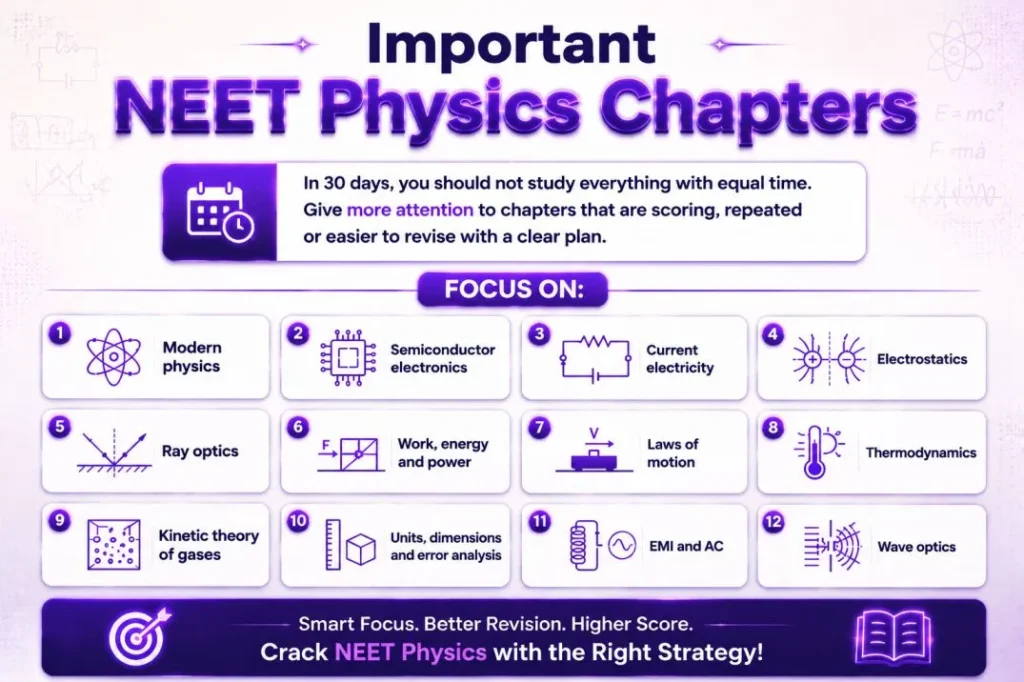
If you want to know how to score good marks in NEET Physics, focus on chapters that offer better returns with limited time.
High-Weightage Chapters That Give Maximum Returns
Prioritise these chapters:
- Modern Physics
- Semiconductor Electronics
- Current Electricity
- Electrostatics
- Ray Optics
- Thermodynamics
- Laws of Motion
- Work, Energy and Power
- Units and Dimensions
- EMI and Alternating Current
Mechanics should not be ignored because chapters like laws of motion and work-energy-power build the problem-solving approach needed for other topics.
What Daily Habits Actually Help Fix NEET Physics Fast?
The best last-minute NEET physics preparation tips are not complicated. Build habits like:
- Revising formulas every day
- Solving questions with a timer
- Maintaining an error notebook
- Revisiting weak chapters
- Practising PYQs regularly
- Analysing mock tests honestly
Students looking for structured support can consider NEET physics coaching in Kolkata, where guided learning, regular practice and doubt-solving can really help.
How Many Hours Should You Study Physics Daily?
- 45 minutes: Concept revision
- 60 minutes: Question practice
- 30 minutes: Mistake analysis
- 15 minutes: Formula revision
Final Takeaway
The right guidance can help with concept-first teaching, numerical practice, regular doubt clearing, mock analysis, and timed tests. You can check more physics preparation strategies in our blog section.
IB Sir offers professional NEET physics coaching in Kolkata and guides the aspirants towards the right direction, thus making physics less scary and making it look simple. Join the class today!
People Also Ask For
Can I improve my NEET Physics score in 30 days?
Yes. Focus on weak concepts, important chapters, PYQs, formula revision, timed practice and mistake analysis.
Which Physics chapters are most important for NEET?
Prioritise Modern Physics, Semiconductors, Current Electricity, Electrostatics, Ray Optics, Thermodynamics, Laws of Motion and Work-Energy-Power.
How many hours should I study Physics daily for NEET?
Two to three focused hours daily with concept learning, question practice, and revision can help improve performance.
Is NCERT enough for NEET Physics?
NCERT builds the foundation, but you also need numerical practice, PYQs, and mock tests.
Should I focus on accuracy or attempting more questions in NEET Physics?
Focus on accuracy first. More attempts without control can increase negative marking.