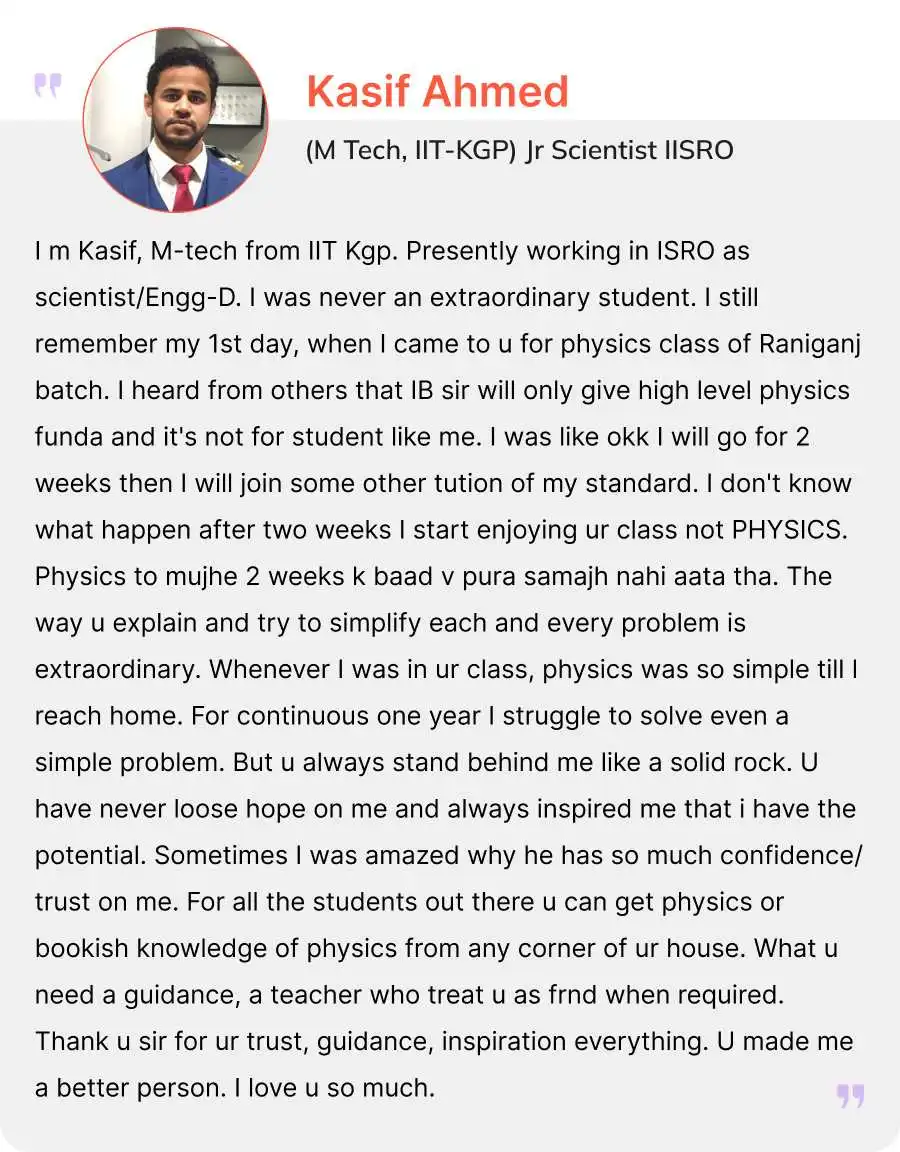

Once, a parent brought their son to our coaching centre. He knew the NEET physics formulas but struggled when a question asked him to apply them.
We see this gap often. A student may revise every equation in a chapter, then get stuck because the exam question describes a situation instead of naming the formula. If that sounds familiar, we can work on it. In this blog, we’ll look at:
- Why knowing a formula may not help someone solve a question
- How to build application skills through practice
- Which chapters need closer attention
Why Do NEET Aspirants Know the Formula but Miss the Answer?
Like that child who couldn’t crack the questions, many others struggle the same way. Imagine a question about the electric field at a point between two charges. You remember (E = F/q), but where do you begin? You must consider the effect of each charge and the direction of each field before choosing your next step.
That is why students wonder why they know NEET physics formulas but can’t apply them. A solved example can show a student what to do. But during an exam, when faced with NEET physics application-based questions, you have to do it all by yourself!
What’s the Real Difference Between Knowing a Formula and Applying It?
Memorising means recalling an equation. Recognising means identifying the principle behind a question. Applying means using that principle with the right conditions, direction, and units.
Take (v = u + at). Knowing the equation is useful. An aspirant still needs to check whether acceleration is constant and choose a positive direction. That is the difference between theory and application in NEET physics: you transition from knowing what an equation says to deciding whether it fits the problem.
Why Does NEET Physics Test Application Instead of Direct Recall?
Physics explains how objects move and interact. The same principle can appear in a diagram, graph or short scenario. Recalling an equation helps, but one must first understand what the question describes.
How Many NEET Physics Questions Are Purely Formula-Based?
There is no fixed official count. The NTA’s 2026 information bulletin lists 45 physics multiple-choice questions, but does not divide them into direct-formula and application questions. The mix can vary between papers.
Even a short numerical question may ask students to interpret a direction, convert a unit or select the correct relationship before calculating.
How Does NEET Hide Familiar Formulas in Unfamiliar Situations?
A question may describe a ball moving upwards without saying “motion under gravity”. Two connected blocks may require a force diagram. A lens question may give an image position but leave you to choose the correct signs.
The principle has not changed; the presentation has. Before trying to memorise an equation, ask: What is happening? What do I know? What must I find?
What Are the Warning Signs You’re Memorising Instead of Understanding?
Look for patterns while practising:
- You can state a formula but cannot explain its terms.
- Can solve a worked example but freeze when the diagram changes.
- Choose an equation just after spotting a familiar word.
- Get the number right but miss the direction or sign.
- Can understand the solution only after someone else shows you the first step.
One wrong answer means little. Repeated errors point to something students can address. If you find yourself asking, “Why can’t I solve NEET physics numericals?”, check whether you are struggling with the concept, question reading, calculation or time pressure.
How Do You Build Application Skills in Physics?
Practise the decisions that come before calculation. These NEET physics conceptual clarity tips can help students turn a familiar formula into a useful method.
Why Should You Start From the Concept, Not the Formula?
Describe the situation in plain words first: “The object is slowing down,” or “Both charges affect this point.” Then identify the principle and write an equation.
This helps to catch a wrong assumption early. If you want to learn how to apply physics concepts in NEET, start by explaining what the question shows, then choose the right relationship.
How Does Solving Varied Problems Build Recognition Skills?
Begin with straightforward questions after learning a concept. Then change the format: try a graph, a diagram, a reverse question and one that combines two ideas. After each, explain why you chose that method.
If every practice question sits under a chapter heading, you already have a clue the exam may not give you. Mix topics once you have learnt them separately.
Why Do Diagrams and Visualisation Matter More Than People Think?
A quick sketch can make a long question easier to read. Arrows show forces and fields. Ray diagrams help you follow light. A motion graph shows how quantities change.
Keep the drawing simple. Label what you know and what you need to find; then use it to guide your reasoning.
Which NEET Physics Chapters Punish Formula-Only Preparation the Most?
Mechanics requires students to identify forces, directions and links between motion and energy. In electrostatics, the direction of a field or force can change the answer. Optics needs careful ray diagrams and sign conventions. In simple harmonic motion (SHM), aspirants must understand how position, velocity and acceleration relate.
All four areas feature in the official syllabus. Spend the most time on the chapters where mistakes show a gap in understanding.
How Should You Practise to Close the Application Gap?
Try this NEET physics problem-solving strategy:
- Read once for the situation and again for the given quantities.
- Draw a sketch if direction, motion or geometry matters.
- Name the principle before choosing an equation.
- Solve, then check the units, sign and size of the answer.
- Record why you missed the question and retry it later.
Pro Tip: If you’re wondering how to improve NEET physics numericals, practise chapter-wise questions and mixed sets from previous-year papers. Add timed practice once you can solve them accurately.
Formulas Are the Starting Point, Not the Finish Line
A formula gives students a tool. Conceptual understanding tells when and how to use it. If unfamiliar questions stop you today, review your mistakes, vary your practice, and pause to think before you calculate.
At Study with IB in Kolkata, our NEET physics coaching includes:
- concept explanations,
- personalised guidance,
- and exam strategies.
If your child needs a NEET physics coaching centre in Kolkata, or you know someone who does, feel free to reach out.
What People Also Ask
Why Do Students Forget How to Apply a Formula They’ve Memorised?
They may recall the equation but not recognise when to apply it. Practising how to identify the principle behind each question can help.
Is NEET Physics More About Formulas or Concepts?
Both matter. Concepts help students choose a suitable formula; formulas help them calculate the answer.
How Many Numerical Questions Appear in NEET Physics?
There is no fixed official count of numericals. The 2026 paper had 45 Physics questions that test concepts and calculations in different ways.
What Is the Fastest Way to Improve Application-Based Problem Solving?
Students can identify their most common error type, review the relevant concept, and solve a small set of varied questions. They should check their reasoning after each one.
Should NEET Aspirants Use Multiple Books or Focus on NCERT?
NCERT and previous-year NEET questions are a useful starting point. Another question source can add variety once you use those well.
How Can Students Tell Whether They Understand a Concept?
They should be able to explain it without notes, draw an example and solve a question that looks different from the one they learnt.
Can Previous-Year Papers Alone Fix the Problem?
They can reveal gaps. Students also need to revise the concepts behind mistakes and practise those question types again.
Which Chapters Need the Most Conceptual Practice?
Mechanics, electrostatics, optics and SHM are useful areas to check. Students should prioritise chapters where they repeatedly make reasoning errors.
Is It Too Late to Improve a Few Months Before NEET?
No. Students can focus on recurring errors, revise the relevant concepts and practise under timed conditions once their accuracy improves.
Can Coaching Help More Than Self-Study With This Problem?
Coaching can help a student spot a reasoning gap they keep missing. Independent practice is still needed to make the method familiar.