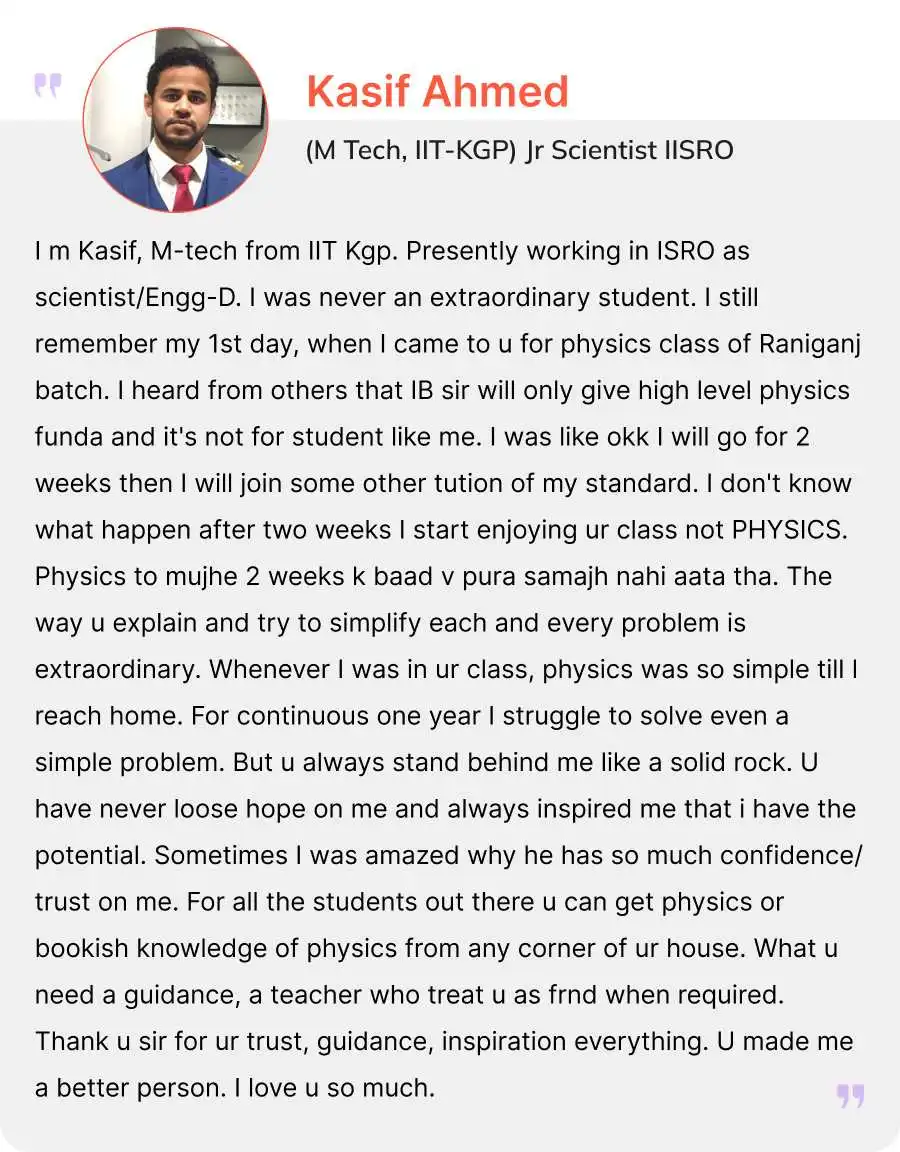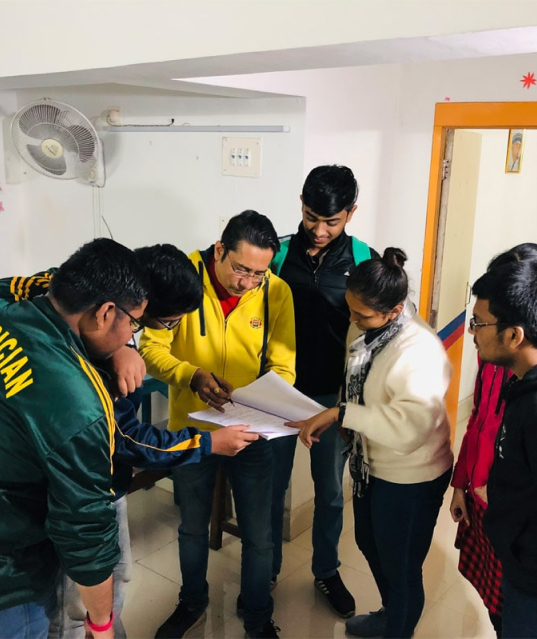
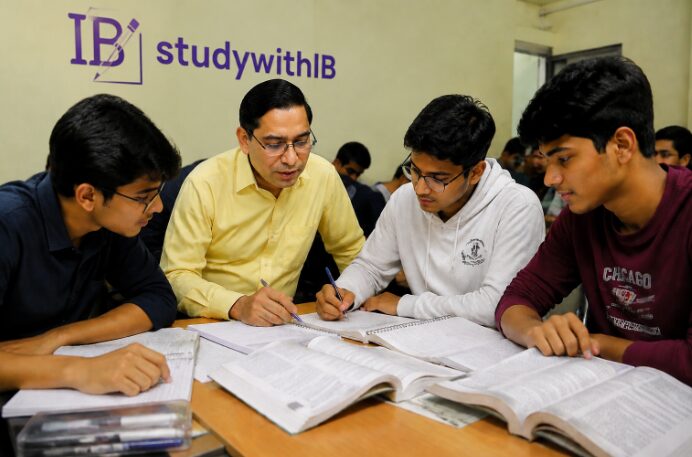
Two students can study for the same amount of time but get totally different results. One spends four hours just watching lectures. The other spends two hours actively learning, solving, and reviewing.
When it comes to physics preparation for JEE (Joint Entrance Examination), there is no magic number of hours. It all depends on your child’s class, strengths, and target exam. However, there is no need to worry. In this blog, we have answered the question, "How many hours to study physics for JEE?" and tried to clear all your doubts.
Why Does “How Many Hours” Even Matter for JEE Physics?
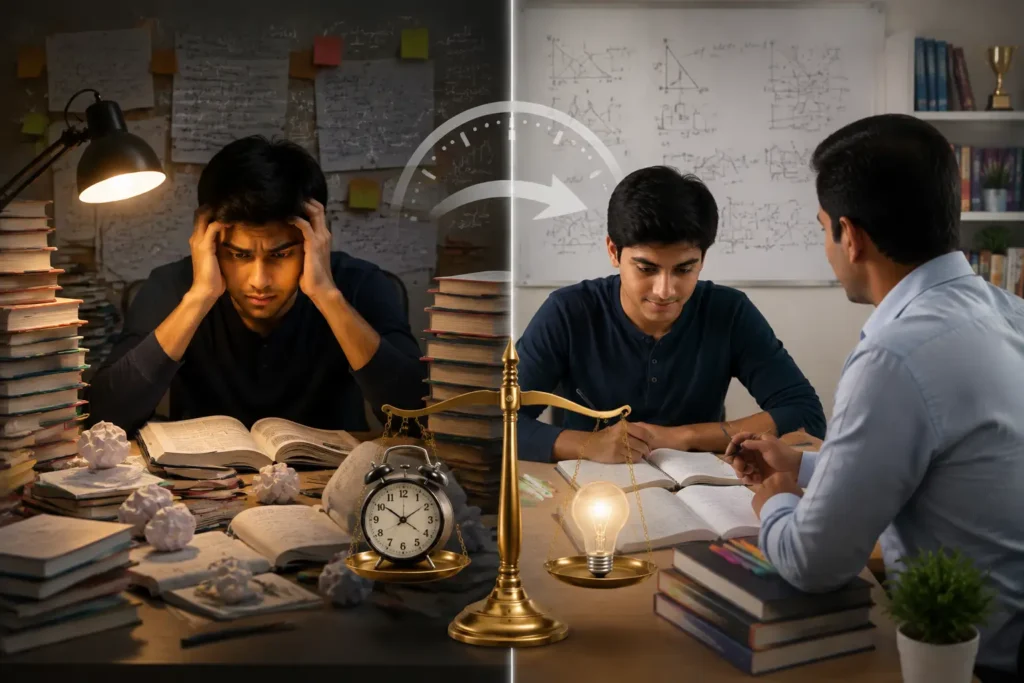
Hours matter because the Joint Entrance Examination requires regular practice, but quality matters more than the clock.
In JEE Main Paper 1, Physics, Chemistry, and Mathematics each carry 100 marks, while JEE Advanced has two compulsory three-hour papers designed to test comprehension, reasoning, and analytical ability. That means the study time must cover four things:
- Learning concepts
- Solving problems
- Revising what has already been learnt
- Analysing mistakes
Spending hours at the desk is useless if only a small portion is productive. A sensible daily study time for JEE physics should therefore be based on what one can understand and apply, not simply how long they sit with a book.
How Many Coaching Hours Are Ideal at Each Stage of JEE Preparation?
The number of coaching hours needed for this entrance exam varies at each stage. Coaching should support your child’s preparation, not take time away from independent practice.
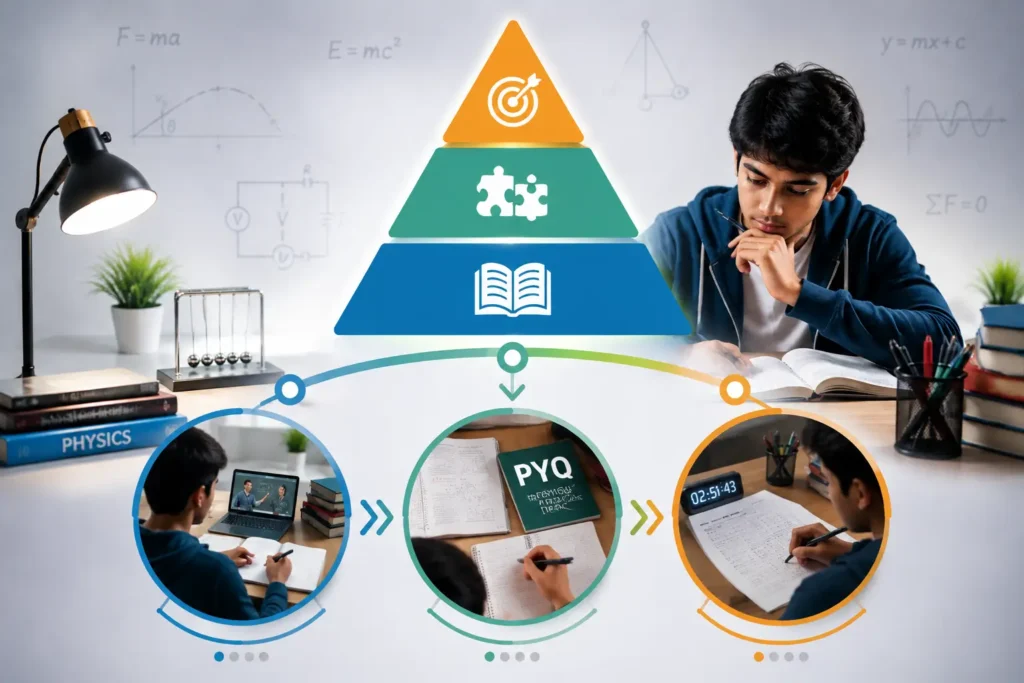
How Many Hours Are Needed in Class 11?
For Class 11, students can consider 4–6 hours a week of focused work on the subject, including guided classes, practice, and revision.
A typical week could look like:
- 2–3 hours of guided teaching
- 2 hours of problem-solving
- 1 hour of revision
Focus on building strong fundamentals in mechanics, units and measurements, motion, and other core areas. At this stage, don’t rush through the chapters. Focus on approaching problems independently.
How Many Hours Are Needed in Class 12 To Complete the Syllabus?
In Class 12, aspirants should aim for 5–8 hours per week, depending on their school workload, coaching structure, and current level. A good weekly cycle is:
Class → same-day revision → problem practice → PYQs → weekly review
How Many Hours Are Needed in the Final Revision Year (Drop Year/Last 6 Months)?
A dropper or student in the final six months may need around 8–12 focused hours per week, depending on the syllabus backlog and target level. This does not mean spending 12 hours in classes. A practical split could be:
- 3–5 hours guided learning
- 3–4 hours problem-solving
- 1–2 hours revision and test analysis
What Should a Realistic Daily Physics Study Schedule Look Like?
A useful JEE physics study plan gives every hour a job. If an aspirant attends a class but doesn't revisit the topic afterwards, they lose much of the learning opportunity.
How Much Time Should Go to Coaching Classes vs Self-Study?
For a student attending a two-hour class, 2–3 hours of independent work on the same day can be a sensible target.
| Activity | Suggested time | Purpose |
| Coaching class | 2 hours | Learn and clarify concepts |
| Self-practice | 2 hours | Apply concepts |
| Revision | 1 hour | Recall and correct mistakes |
| Total | 5 hours | Complete learning cycle |
This is a sample, not a compulsory timetable. It depends on a student's capability and preparation.
This is also where self-study vs coaching hours for the Joint Entrance Examination becomes important: coaching gives direction, but self-study is where independent problem-solving develops.
How Much Time Should Go to Numerical Practice vs Theory?
Once a topic is clear, divide the two-hour self-study session like this:
| Activity | Time | Focus |
| Concepts & formulas | 30–40 min | Understand and recall |
| Numerical practice | 70–80 min | Apply concepts |
| Mistake review | 10–20 min | Find and fix errors |
Start with basic questions, then move to standard JEE problems and tougher applications. This keeps practice focused without spending too much time on questions beyond your child’s current level.
Is More Coaching Hours Always Better for JEE Physics?
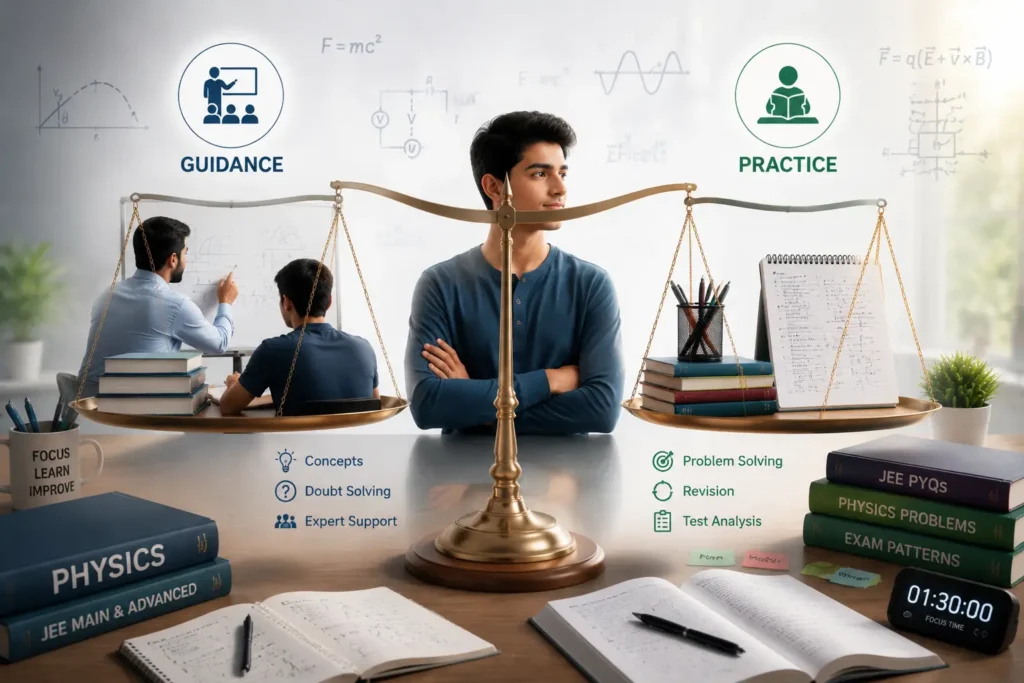
No. More classes can actually hurt preparation when they leave too little time for practice. Too many classes can lead to:
- Less time for questions
- Growing homework backlogs
- Poor revision
- Mental fatigue
- Dependence on solved examples
The purpose of coaching is to make independent study more productive. It should not replace it.
How Do Top Rankers Actually Divide Their Physics Study Time?
No fixed timetable exists that smart students follow. Toppers usually follow a simple cycle:
Learn → Practise → Analyse → Revise → Repeat
After class, students solve related questions, review mistakes and revisit weak concepts after a few days. They also balance this with Maths, Chemistry, tests and proper rest. The goal is not longer study hours, but better use of them.
How Should You Adjust Study Hours Based on Your Weak and Strong Chapters?
Devote time to chapters based on the following formula:
| Chapter status | How to use time |
| Strong | Short revision + mixed questions |
| Average | Regular practice + PYQs |
| Weak | Concept rebuilding + guided practice |
| Very weak | Extra support before advanced questions |
Mechanics may require more time if the basics are weak because several later problems depend on its concepts. Electrodynamics often needs sustained problem practice because different ideas may appear together. Modern physics may take less time for a student with strong fundamentals, leaving more time for difficult areas. This is how to manage time for JEE physics.
How Many Hours Should You Dedicate to Physics vs Chemistry and Maths Combined?
Don't let one subject take over the entire preparation. For 6 hours of daily self-study, a balanced starting point could be:
| Subject | Starting time |
| Physics | 2 hours |
| Chemistry | 2 hours |
| Mathematics | 2 hours |
If one subject is significantly weaker, temporarily give it an extra 30–60 minutes. Reduce that extra time once the gap begins to close. The JEE preparation timetable for physics should fit into the wider PCM plan rather than operate separately.
What Are Signs You’re Studying Too Little or Too Much Physics Daily?
| Studying too little? These are the signs | Studying too much? These are the signs |
| Chapters remain unfinished | Cannot remember yesterday's work |
| Homework regularly piles up | Careless errors are increasing |
| Forget concepts between classes | Sleep is being reduced regularly |
| Rarely solve questions independently | Neglecting Chemistry or Mathematics |
| Mock-test performance remains unchanged | Feeling mentally exhausted before practice begins |
An ideal study schedule for Joint Entrance Examination aspirants should be challenging enough to create progress but sustainable enough to follow for months.
What’s a Good Starting Point for Your Daily Physics Hours?
For many students, 2 hours of coaching plus 2–3 hours of self-study on class days is a practical starting point. But adjust it based on the preparation stage, school schedule, and test performance.
If your child still needs help deciding on the right routine, reach out to a JEE physics tutor in Kolkata. Our team can assess your little one’s current level and identify whether there’s a need for more teaching, more practice, or simply better revision.
Connect now for more information!
Frequently Asked Questions
1) How many hours should a Class 11 student study physics daily?
Around 1–2 focused hours outside school and regular classes can be a reasonable starting point. Increase the time if concepts or practice start to slip.
2) Is 2 hours of physics coaching enough for JEE?
Yes, two hours can be enough for a class if aspirants follow it with independent problem-solving and revision. Coaching alone is not sufficient.
3) How many hours do JEE toppers study physics per day?
There is no fixed topper routine. Smarter students generally prioritise consistent learning, problem-solving, revision and test analysis over a specific number of hours.
4) Should physics study hours increase closer to JEE Main and Advanced?
Practice and test-analysis time can increase closer to the exam. However, simply adding hours isn't useful if retention, accuracy, and sleep begin to suffer.
5) Is self-study enough for JEE physics without coaching?
Yes, some students can prepare independently. Coaching becomes useful when your child needs structured teaching, doubt support, regular tests or help identifying weak areas.
6) How many hours of physics coaching per week is ideal?
Around 3–5 hours of guided teaching per week can work well for many students, with additional self-practice. The right amount depends on an aspirant’s stage of preparation.
7) Can you crack JEE with 4-5 hours of total daily study?
It can be possible for some students, but there is no universal minimum. The starting level, preparation duration, study quality and target rank all affect the required time.
8) How much time should be given to physics numericals vs theory daily?
Once the concept is clear, spend about 60–70% of the study time on problem-solving and 30–40% on theory, formulas, and revision. Temporarily increase theory time when rebuilding a weak concept.