
A student enters Class 11 expecting a tougher version of Class 10 physics, but the subject often feels completely different. Concepts become deeper, formulas become less direct, and numericals require more thinking.
That is why many students ask, "Why is Class 11 physics so hard after Class 10?" The issue isn't ability; it is the need to change your learning approach.
In this blog, we will cover:
- The Class 10 vs Class 11 physics difference
- Why numericals feel difficult and how to approach them
- How to build a stronger foundation for future competitive exams
Why Does Class 11 Physics Suddenly Feel So Much Harder?
Class 11 physics feels difficult because students move from learning what happens to understanding why it happens. In Class 10, many questions follow familiar patterns. In Class 11, students need to connect concepts, apply formulas correctly, and analyse situations before solving problems.
The transition becomes easier when students focus on:
- Understanding concepts instead of memorising formulas
- Practising questions regularly
- Connecting mathematics with physical situations
What’s Actually Different Between Class 10 and Class 11 Physics?
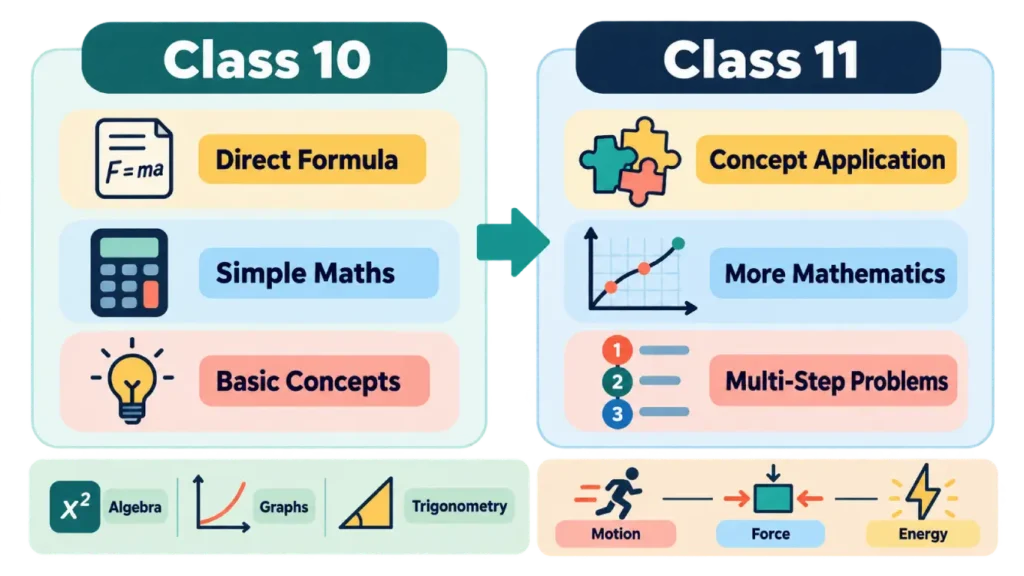
The biggest difference between Class 10 and Class 11 physics is the shift from direct application to deeper conceptual thinking. Class 11 requires students to think beyond textbook examples and understand how different concepts connect.
How Does the Syllabus Change in Depth and Scope?
The Class 11 physics syllabus overview introduces broader topics such as:
- mechanics
- laws of motion
- work, energy and power
- gravitation
- thermodynamics
- waves
These chapters build on each other. For example, understanding motion helps students learn force and energy concepts more effectively.
Why Does Mathematics Play a Bigger Role in Class 11 Physics?
Mathematics becomes more important because students need to convert concepts into calculations. Students should strengthen:
- Algebra
- Graph interpretation
- Basic trigonometry
- Unit conversion
- Numerical calculations
Weak maths basics can make a physics question appear more difficult than it actually is.
How Does the Shift From Descriptive to Conceptual Learning Happen?
Class 11 physics requires students to think beyond memorised answers.
Students need to understand:
- Why a formula works
- When it should be applied
- How changing conditions affect the answer
This shift helps them solve unfamiliar problems with more confidence.
Which Class 11 Physics Chapters Do Students Find Toughest?
Some chapters feel challenging because they introduce new concepts and require stronger problem-solving skills.
| Chapter | Why students struggle |
| Mechanics | Requires strong basics and logical thinking |
| Laws of motion | Needs clear understanding of forces |
| Work, energy and power | Requires connecting multiple concepts |
| Thermodynamics | Includes abstract ideas |
| Waves | Needs visualisation and application |
Mechanics often becomes the biggest adjustment because it creates the foundation for many advanced topics.
Why Do Numericals Suddenly Feel So Much Harder Than in Class 10?
Class 11 numericals feel difficult because students cannot solve them by simply remembering a formula. They need to understand the situation, identify the concept and choose the correct approach. Follow this method:
- Understand the question.
- Identify the given information.
- Draw a diagram if required.
- Select the correct concept.
- Solve step by step.
These Class 11 physics numerical tips help students move from memorising formulas to applying them.
How Can Students Adapt Their Study Approach for Class 11 Physics?
The biggest change needed in Class 11 is moving from memorising formulas to understanding concepts. Students should focus on why a formula works, where it applies, and how the same idea appears in different questions. A simple learning cycle can help:
Understand the concept → Learn the formula → Solve basic questions → Practise advanced problems → Review mistakes
This approach builds confidence and makes chapters easier to handle.
How Do You Build Concept Clarity Instead of Memorising Formulas?
Formula memorisation alone creates problems when questions are presented differently. For example, knowing a motion equation is not enough unless the student understands the relationship between distance, velocity, and acceleration.
To build stronger concepts:
- Understand the meaning behind every formula
- Draw diagrams wherever possible
- Connect concepts with real-life examples
- Solve different types of questions from the same topic
This method helps students prepare better for both school exams and competitive exams.
How Much Daily Practice Is Actually Needed?
Consistency matters more than studying for long hours once in a while. A focused 1–2 hours of daily practice can help students gradually improve their problem-solving skills.
A practical routine can include:
| Activity | Time |
| Concept revision | 20–30 minutes |
| Numerical practice | 40–60 minutes |
| Mistake review | 10–15 minutes |
Students should focus on solving questions regularly rather than completing large question banks without understanding mistakes.
How Do Visual Aids and Simulations Help With Abstract Topics?
Some Physics concepts are difficult because students cannot directly see them. Visual tools, diagrams and simulations help convert abstract ideas into something easier to understand.
For example:
- Motion graphs help explain changes in speed
- Force diagrams make interactions clearer
- Ray diagrams simplify optics concepts
- Simulations show how variables affect outcomes
These methods make learning more interactive and improve conceptual understanding.
How Does Class 11 Physics Set the Foundation for JEE and NEET?

Class 11 Physics creates the base for many advanced concepts required in competitive exams. Topics introduced at this stage continue to appear in JEE and NEET preparation.
A strong Class 11 foundation helps students with:
- Better problem-solving ability
- Faster numerical solving
- Improved concept application
- Easier revision in Class 12
Chapters like mechanics, laws of motion, work, energy and power, and thermodynamics are especially important because they develop the thinking approach needed for higher-level questions.
Students preparing for competitive exams should avoid treating Class 11 as just another school year. It is the stage where learning habits and fundamentals are built.
Should You Consider Physics Tuition in Class 11?
Physics tuition can help when students need structured guidance, regular doubt-solving, or help understanding difficult concepts. However, not every student needs the same level of support.
Self-study may work well when a student:
- Understands concepts independently
- Maintains regular practice
- Can identify and solve doubts
Guided support can help when a student:
- Finds Class 11 physics difficult after Class 10
- Struggles with numericals
- Has gaps in basic concepts
- Needs a structured study routine
A Class 11-12 physics tutor in Kolkata can help students understand their weak areas, improve problem-solving skills, and build a stronger preparation strategy.
For students looking for Class 11 physics tuition in Kolkata, focus on concept-based teaching, regular practice, and individual attention rather than just completing the syllabus.
The Struggle Is Normal — Here’s the Way Through
Feeling overwhelmed by Class 11 Physics after Class 10 is common. The subject becomes challenging because the learning method needs to change, not because students cannot improve.
Building strong concepts, practising regularly, and clearing doubts early can make Physics much more manageable.
If a student needs structured guidance, IB Sir, an experienced physics teacher in Kolkata, can help create a learning approach that matches their current level and goals.
Our physics tuition centre can provide the right support at this stage, make the transition smoother, and build the confidence needed for future academic and competitive exam success.
What People Also Ask
Is Class 11 Physics really harder than Class 10?
Class 11 Physics is more advanced because it requires deeper understanding, mathematical application, and multi-step problem-solving. With the right approach, students can adapt gradually.
Why can a student understand the theory but still can’t solve numericals?
Theory explains the concept, but numericals require application. Regular practice helps students learn how to identify the right concept and approach each problem.
How many hours a day should an aspirant study Physics in Class 11?
Around 1–2 focused hours daily can be a good starting point. The exact time depends on the student's understanding level, school workload, and preparation goals.
Is it okay to focus on NCERT or reference books for Class 11 Physics?
NCERT is important for building basic concepts. You can add reference books later for extra practice once the fundamentals are clear.
Is it normal to feel lost in the first few months of Class 11?
Yes. Many students struggle during the transition because their learning style changes. Consistent practice helps them adjust.
How is Class 11 Physics different if I’m also preparing for JEE or NEET?
Competitive exams require stronger application skills. Students need more numerical practice, concept clarity, and regular revision than for school-level preparation alone.
What’s the best way to catch up if I’m already behind in Class 11 Physics?
Start by identifying weak chapters, rebuilding basic concepts, and practising important questions regularly. Avoid trying to complete everything at once.
Is a Physics tutor needed, or can one self-study Class 11 Physics?
Self-study can work for disciplined students. A tutor can help when students need guidance, doubt-solving, and a structured learning plan.
Which Class 11 Physics chapters are most important for JEE/NEET?
Chapters like mechanics, laws of motion, work, energy and power, thermodynamics, and waves are important foundations for competitive exams.
How to stop forgetting formulas during exams?
Instead of memorising formulas repeatedly, understand their meaning, practise applying them, and revise them through regular problem-solving.