Are you preparing for boards and simultaneously juggling JEE Physics preparation?
Board exams are already a stressful phase, and on top of that, preparing for JEE Physics can feel overwhelming.
Every year, students dive into JEE preparation and board exams together, but most struggle because they lack a solid plan.
At Study with IB, a Physics coaching centre for JEE in Kolkata, under the guidance of IB Sir, you get a structured approach that helps you prepare once and perform confidently.
Why Preparing Physics Together for Boards and JEE Is the Smartest Strategy
The real challenge isn’t the syllabus; it is the strategy you follow.
Most students unknowingly study the same chapters twice, wasting time and causing unnecessary pressure.
When you prepare Physics in a combined way, you cut down repetition, save energy, and build a stronger understanding that works for both boards and JEE.
Where the syllabus overlaps
Did you know 70–80% of JEE Main comes straight from your board syllabus?
Core topics such as Thermodynamics, Kinetics, Organic Chemistry, Modern Physics, Electrostatics, and Calculus are common, allowing them to be prepared together with a single, well-planned approach.
Board Physics vs JEE Physics
Same chapters, different expectations. This is where most students get confused.
You need a proper approach for how to prepare for boards and JEE simultaneously in Physics.
Let’s hope this brief explanation can clear your confusion.
| Aspect | Board Physics | JEE Physics |
| Focus | Theory, derivations, presentation, and step marking | concepts, application, speed, and accuracy |
| Question Type | Subjective, long answers | MCQs, numericals |
| Answer Style | Step-by-step with proper presentation | Direct, quick problem-solving |
| Marking Scheme | Step marking, presentation matters | Final answer accuracy matters |
| Speed Requirement | Moderate | High (time-bound solving) |
| Concept Depth | Basic to moderate understanding | Deep conceptual clarity |
| Practice Needed | Writing answers and derivations | Solving MCQs and PYQs |
| Common Mistake | Ignoring presentation and steps | Ignoring accuracy and speed |
| Preparation Style | Learn → Write → Revise | Learn → Apply → Practice |
The Best 3-Step Method to Study Every Physics Chapter Once
Instead of switching between two strategies, follow a smart approach for the board exam and JEE Physics preparation. This method helps you build concepts, improve answer writing, and strengthen problem-solving.
| Step | Focus Area | What You Should Do |
| Step 1: Learn the NCERT theory and derivations first | Build strong fundamentals | Read the NCERT line by line to build a strong base Focus on definitions, formulas, and important concepts Practice important derivations for board exams Make short notes for quick revision |
| Step 2: Solve board-style numericals and subjective questions | Improve answer writing | Practice writing step-by-step answers Focus on presentation, units, and proper explanation Solve NCERT examples and back exercises Attempt board sample papers for clarity |
| Step 3: Practice JEE-level MCQs and PYQs from the same chapter | Strengthen problem-solving | Start with basic MCQs, then move to advanced problems Solve previous year JEE questions regularly Work on speed and accuracy with timed practice Analyse mistakes and revise weak concepts immediately |
Physics Chapters You Can Prepare Once for Both Boards and JEE
Some chapters in Physics are common and highly scoring for both boards and JEE. If you prepare for them smartly once, you can perform well in both exams.
These are areas common to both boards and JEE.
Electrostatics
- Strong focus on basic concepts like charge, electric field, and potential
- Important derivations (Gauss’s law, potential due to charges) for boards
- Numericals based on field and potential for JEE
- Diagrams and formula clarity are important
Current Electricity
- Learn Ohm’s law, Kirchhoff’s laws, and circuit analysis
- Practice step-by-step numerical solving for boards
- Focus on quick calculations and shortcuts for JEE MCQs
- Regular formula revision is essential
Magnetism and Moving Charges
- Understand concepts like magnetic field, force on charges, and Biot-Savart law
- Practice derivations and diagrams for board exams
- Solve application-based problems for JEE
- Focus on direction-based questions and right-hand rules
Electromagnetic Induction and AC
- Important laws like Faraday’s law and Lenz’s law for boards
- Practice derivations and theory questions
- Solve numericals involving inductance, reactance, and AC circuits
- Focus on conceptual clarity for JEE questions
Ray Optics and Wave Optics
- Learn ray diagrams, lens formula, and mirror concepts
- Practice diagram-based answers for boards
- Solve numericals on interference, diffraction, and lenses
- Focus on accuracy in sign conventions
Best Books and Resources for Boards + JEE Physics Preparation
A focused preparation always starts with the right resources. The biggest mistake students make is jumping between multiple books without mastering the basics.
Your first priority should always be NCERT Physics for boards and JEE, as it builds the foundation for both theory and concepts.
NCERT Physics
- Read line by line for concepts, definitions, and derivations
- Solve all examples and back exercises
- Revise diagrams and formulas regularly
Board sample papers and previous year papers
- Helps improve answer writing and presentation
- Understand marking schemes and frequently asked questions
- Practice under timed conditions
JEE Main PYQs and mock tests
- Builds speed and accuracy
- Helps identify important concepts and patterns
- Regular practice improves confidence
Reference books only after NCERT mastery
- Use only when your basics are clear
- Avoid multiple sources to prevent confusion
The best way to prepare for Physics for JEE and board exams is given below:
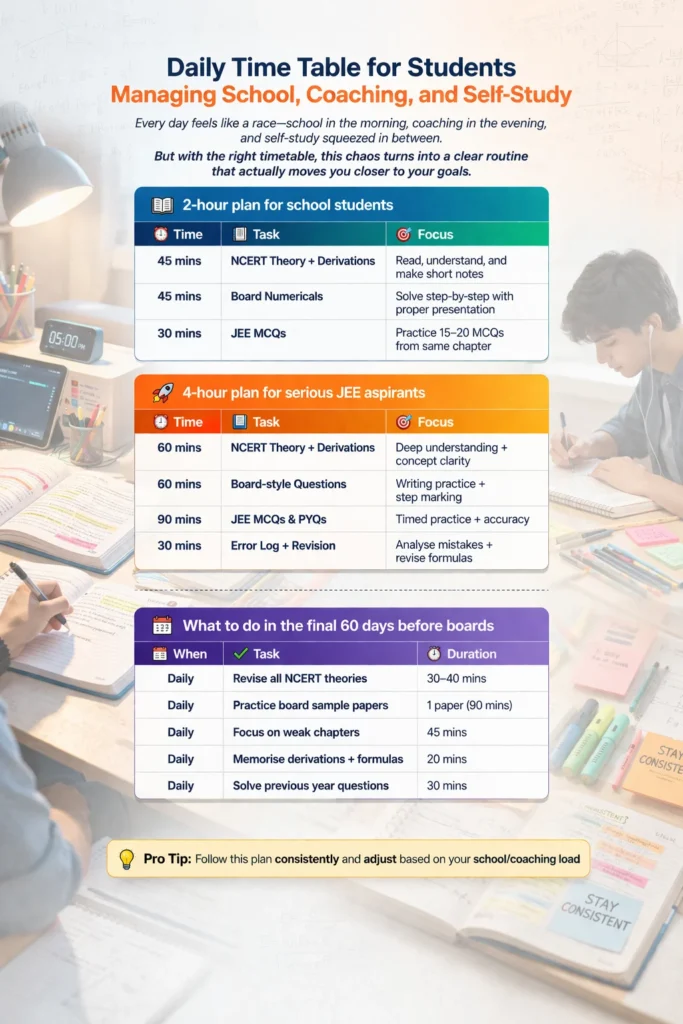
Daily Time Table for Students Managing School, Coaching, and Self-Study
Most days feel like you’re just trying to keep up with school, coaching, and endless tasks.
But the right timetable helps you take control rather than feel overwhelmed.
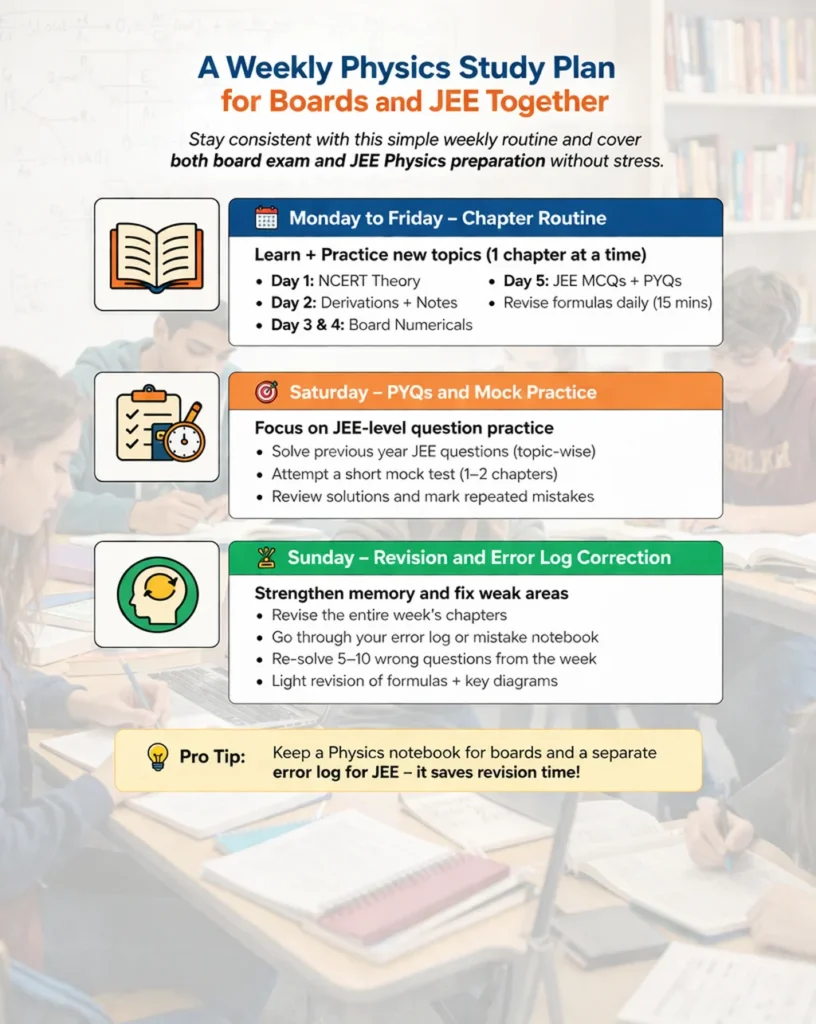
A Weekly Physics Study Plan for Boards + JEE Together
A consistent weekly plan is what turns preparation into real results. When structured properly, you can manage both boards and JEE without feeling overwhelmed.
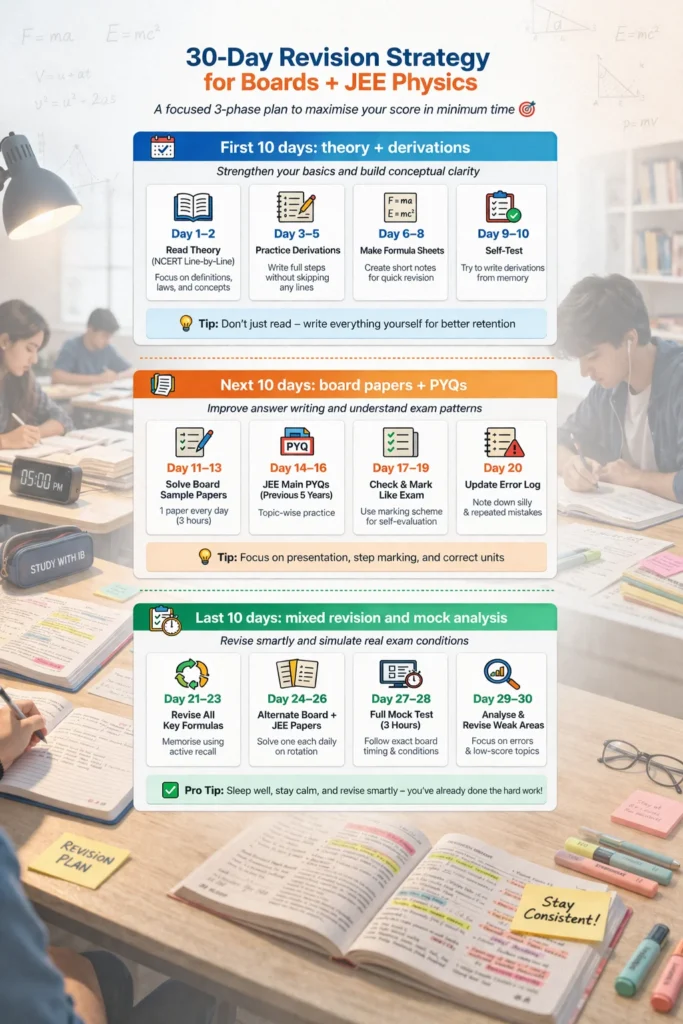
30-Day Revision Strategy for Boards + JEE Physics
A well-planned 30-day revision can turn your preparation into real results. With the right focus on theory, practice, and analysis, you can strengthen both boards and JEE performance together.
To make this revision phase more effective and less stressful, many students rely on expert guidance from Study with IB, a trusted physics coaching centre for JEE in Kolkata, where structured revision plans help you stay consistent and exam-ready.
Physics Preparation Tips for Kolkata Students Appearing for Boards and JEE
Students often juggle school, coaching, and self-study, which makes planning crucial. A focused approach helps manage everything without burnout.
This is where structured guidance from Study with IB, offering JEE Physics coaching in Kolkata for board preparation, plays an important role in keeping your preparation aligned and stress-free.
How CBSE, ISC, and WB board students should adjust the same strategy
- Keep NCERT as the base and align with your board pattern
- Focus more on writing practice if your board demands it
How to balance school workload and coaching schedule
- Fix a daily routine with dedicated Physics time
- Avoid overloading and focus on consistency
When to focus more on boards and when to shift to JEE mode
- Before boards: prioritise theory, derivations, and writing
- After boards: shift fully to MCQs and mock tests
Let’s Recap
Preparing for boards and JEE together is not about studying more; it is about studying smart. By focusing on common topics, mastering NCERT Physics for boards and JEE, and practising both writing and MCQs, you can improve performance in both exams without extra pressure.
Visit Study with IB, a physics coaching centre for JEE in Kolkata, where IB Sir guides you with a proven strategy to score.
Call +91 9474114212 for admission-related queries today.
People Also Ask
- Is NCERT enough to prepare for both Physics boards and JEE at the same time?
NCERT is enough to build strong fundamentals and score well in boards. For JEE, you’ll need additional MCQ practice and previous year questions.
- Is board Physics enough for JEE Main?
Board Physics gives you the base, but JEE requires deeper application and speed. You must practice MCQs and numerical problems beyond theory.
- How many hours should be spent studying Physics daily?
Ideally, 2–4 hours daily is enough if you study with focus and consistency. Quality matters more than quantity. Avoid long but unproductive study hours.
- Which Physics chapters are most important for both boards and JEE?
Electrostatics, Current Electricity, Optics, and Modern Physics are highly important. These chapters are common, scoring, and frequently asked in both exams.