

Ever heard of the phrase “practice makes a man perfect”? Parents always use this to motivate their children.
But does practice always guarantee better results? Not really.
Students keep practising, yet their marks don’t improve. The real issue is that while they focus on doing more questions, they often skip analysing where they are going wrong. And that is exactly where performance starts to drop.
In this blog, we’ll break down the common mistakes students make during NEET Physics preparation and the smarter strategies that can truly improve accuracy.
Why Daily Practice Alone Does Not Improve NEET Physics Accuracy?
Are you analysing where you are going wrong in the preparation?
If not, then you are making a huge mistake. Accuracy comes from properly analysing mistakes. Daily practice without proper, structured analysis leads to the repetition of mistakes rather than to conceptual understanding.
Practice volume vs practice quality
Solving 100 questions mindlessly will never beat solving 30 questions with proper understanding. Quality practice means reviewing each mistake, identifying the concept gap, and correcting your approach before moving ahead.
Why do students repeat mistakes even after solving many questions
When mistakes are not analysed, they become a habit rather than an exception.
| Problem | What It Leads To |
| No mistake analysis | Repeating the same errors |
| Ignoring weak concepts | Low conceptual clarity |
| Practising without revision | Temporary understanding |
| No error tracking | No measurable improvement |
| Rushing through questions | Silly mistakes in exams |
The 7 Hidden Mistakes That Keep Your NEET Physics Accuracy Low

Don’t worry; if mistakes are being made, they can be corrected. First, let’s identify the common mistakes you are making in NEET Physics preparation you are making.
1. Solving questions before understanding the concept
Most students have the habit of jumping straight to solving questions rather than understanding the concept. This affects when the questions in the exam come a little trickier, and they struggle to answer them. It happens due to a lack of conceptual clarity.
2. Memorising formulas but not knowing when to apply them
Students focus on memorising formulas, thinking it will help them solve questions faster. However, this often leads to confusion because they struggle to identify when and where to apply the correct formula. Without understanding the underlying concept, formulas become difficult to use effectively, leading to incorrect answers even when you know them.
3. Ignoring unit conversion, sign convention, and approximation errors
Small calculation details are often ignored, but they play a major role in determining accuracy.
- Using wrong or inconsistent units in calculations
- Missing negative or positive signs in equations
- Incorrect approximations leading to calculation errors
- Not converting units before applying formulas
- Rounding off values too early in the solution
4. Practising untimed and expecting timed-exam accuracy
Always study with a timer to build both speed and focus. If you are solving 20 questions, set a clear time limit and aim to finish a few minutes early. This trains your brain to work efficiently under pressure.
5. Not maintaining an error notebook for Physics
It is one of the most effective ways to improve accuracy.
Writing down your mistakes, whether conceptual or calculation-based, helps you identify patterns over time. Revisiting this notebook a week or a month before the exam ensures you don’t repeat the same errors and strengthens your revision.
6. Spending too long on difficult numericals
One of the most common mistakes in NEET Physics numericals is getting stuck on a single question. Students often spend too much time trying to solve it, which affects their speed and confidence during the exam.
This leads to poor time management and missing out on easier, scoring questions that could boost overall marks.
7. Analysing marks but not analysing mistake patterns
Aspirants focus only on their scores after a test, ignoring the reasons behind their mistakes. Knowing your marks alone does not help improve performance unless you understand where you went wrong.
Identifying repeated error patterns and weak areas is essential to improving accuracy and avoiding the same mistakes in future tests.
At Study with IB, students are guided to identify and correct these exact mistakes with structured strategies. Under the mentorship of IB Sir, widely regarded as the best physics teacher in Kolkata for NEET preparation, preparation becomes more focused, strategic, and results-oriented.
How to Identify What Type of Mistake You Are Making in NEET Physics
Understanding the common mistakes in preparing for NEET Physics starts with identifying the types of errors you consistently make during practice and tests.
Conceptual mistakes
These mistakes prevent prioritising formula memorisation over fundamental understanding.
It leads to:
- Errors in mechanics (sign conventions, free-body diagrams),
- Thermodynamics (isothermal vs. adiabatic processes), and
- Electromagnetism (direction of current/field)
Calculation mistakes
Are you missing roughly 35-40 marks in the exam? It is due to a calculation mistake.
Calculation mistakes in NEET Physics often stem from missing units (e.g., cm to m), neglecting sign conventions in optics/thermodynamics, and rushing through basic arithmetic.
Question-interpretation mistakes
A common problem is a lack of clarity that leads to incorrect interpretations of the questions.
These are common mistakes that happen due to this:
- Missing important words
- Neglecting unit conversions
- Ignoring sign conventions
- Confusing similar terms
- Misinterpreting Vector vs. Scalar
Time-management mistakes
The most common mistake is poor time management. This mistake leads to :
- Too much time is spent on difficult numericals,
- Skipping tough questions and
- Leaving the OMR sheet marking for the last minute.
Panic-based exam mistakes
Panic during the exam can turn even easy NEET Physics questions into avoidable mistakes.
- Misreading questions due to the hurry
- Missing sign conventions (+ / –)
- Rushing calculations without checking
- Getting stuck on one difficult problem
- Poor time management across the paper
To avoid this:
- Start with easier questions to build confidence
- Skip lengthy problems and return later
- Fill the OMR in sets of 5–10 to minimise errors
How to Improve Accuracy in NEET Physics Faster
Do you spend hours practising, but accuracy stays low? Is it because the method never changed?
Let get to know in detail:
| Strategy | What You Should Do | How It Improves Accuracy |
| Use a chapter-wise error log | Maintain a notebook to track mistakes from each chapter | Helps identify patterns and avoid repeating the same errors |
| Solve in a stepwise format | Follow concept → formula → substitution while solving | Reduces calculation mistakes and improves clarity |
| Follow a 1-minute rule for tough questions | Skip questions if stuck for more than a minute and return later | Saves time and prevents panic during exams |
| Mix easy, moderate, and tricky numericals | Practise a balanced set of questions daily | Builds adaptability for all difficulty levels |
| Review mistakes within 24 hours | Revisit errors soon after practice or tests | Strengthens retention and corrects concepts quickly |
Mock Tests: The Missing Link Between Daily Practice and Higher Accuracy
Mock tests help improve accuracy in NEET Physics, require reliability, and are good for best practice during exams.

High-Weightage NEET Physics Chapters Where Accuracy Commonly Drops
You have studied these chapters before, but they’re still costing you marks. Why?
Because high-weightage topics are also the most error-prone under exam pressure. Mastering them isn’t optional.
Here’s a clear breakdown of the important chapters and their expected weightage from Class 11 and 12 for NEET 2026.
| Chapter | Focus Area for Accuracy |
| Mechanics | Concept clarity, diagrams, formulas |
| Electrostatics & Current Electricity | Calculations, circuits, precision |
| Thermodynamics & Kinetic Theory | Concepts, sign conventions |
| Ray Optics & Modern Physics | Formulas, diagrams, and theory clarity |
A 7-Day Accuracy Improvement Plan for NEET Physics Aspirants
This 7-day plan may act as a saviour during your preparations:
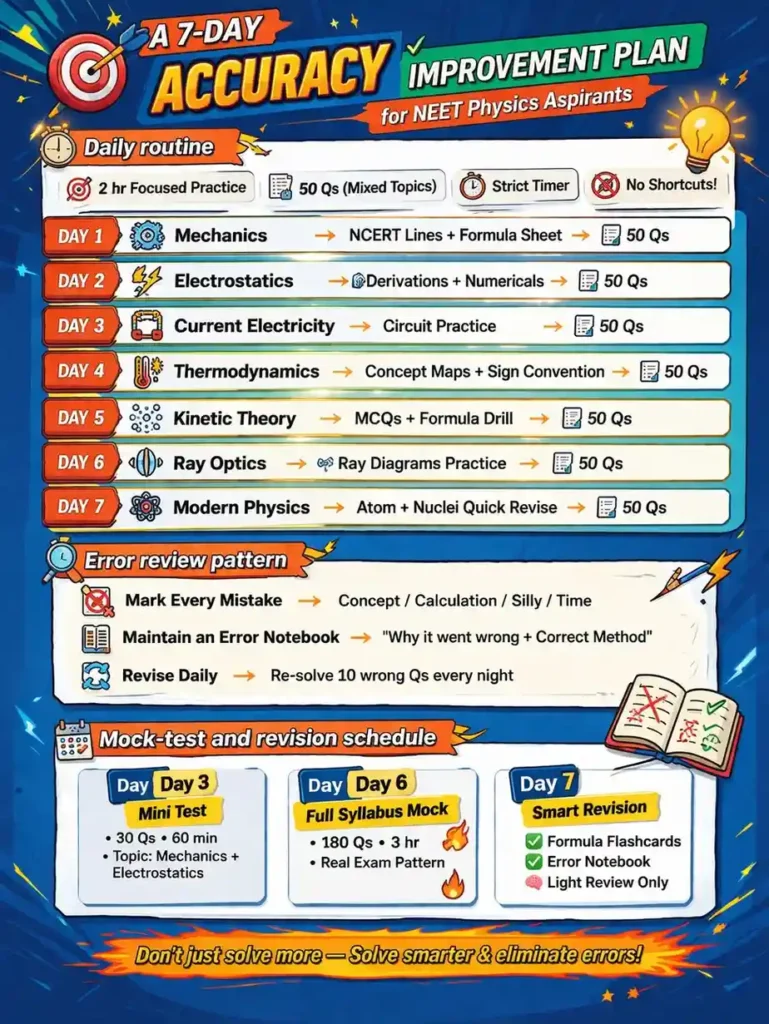
Stop Practicing Blindly, Start Correcting Precisely
Accuracy in NEET Physics is not built by practice alone but by understanding your mistakes. Ignoring error patterns, rushing calculations, and avoiding mock tests can hold back your performance.
A structured approach with regular analysis and concept clarity is essential for improvement. Guidance from IB Sir, the best physics teacher in Kolkata for NEET.
For admission-related queries, contact Study with IB at +91 9474114212
People Also Ask
- Why is my NEET Physics accuracy not improving despite daily practice?
Because practice without analysing mistakes leads to repetition of errors. Accuracy improves only when you identify and correct where you are going wrong.
- How to Improve Speed and Accuracy in NEET Physics?
Solve questions with a timer and follow a stepwise approach. Regular mock tests and error analysis help build both speed and precision.
- How many Physics numericals should I solve daily for NEET?
Focus on quality over quantity—30–50 well-analysed questions are enough. Make sure you review mistakes instead of just solving more.
- Can mock tests improve NEET Physics accuracy?
Yes, mock tests simulate real exam pressure and highlight weak areas. Analysing them properly helps you avoid repeating mistakes.
- What are the most common mistakes in NEET Physics?
Common mistakes include weak concepts, calculation errors, and poor time management. Ignoring error analysis and rushing through questions also reduces accuracy.