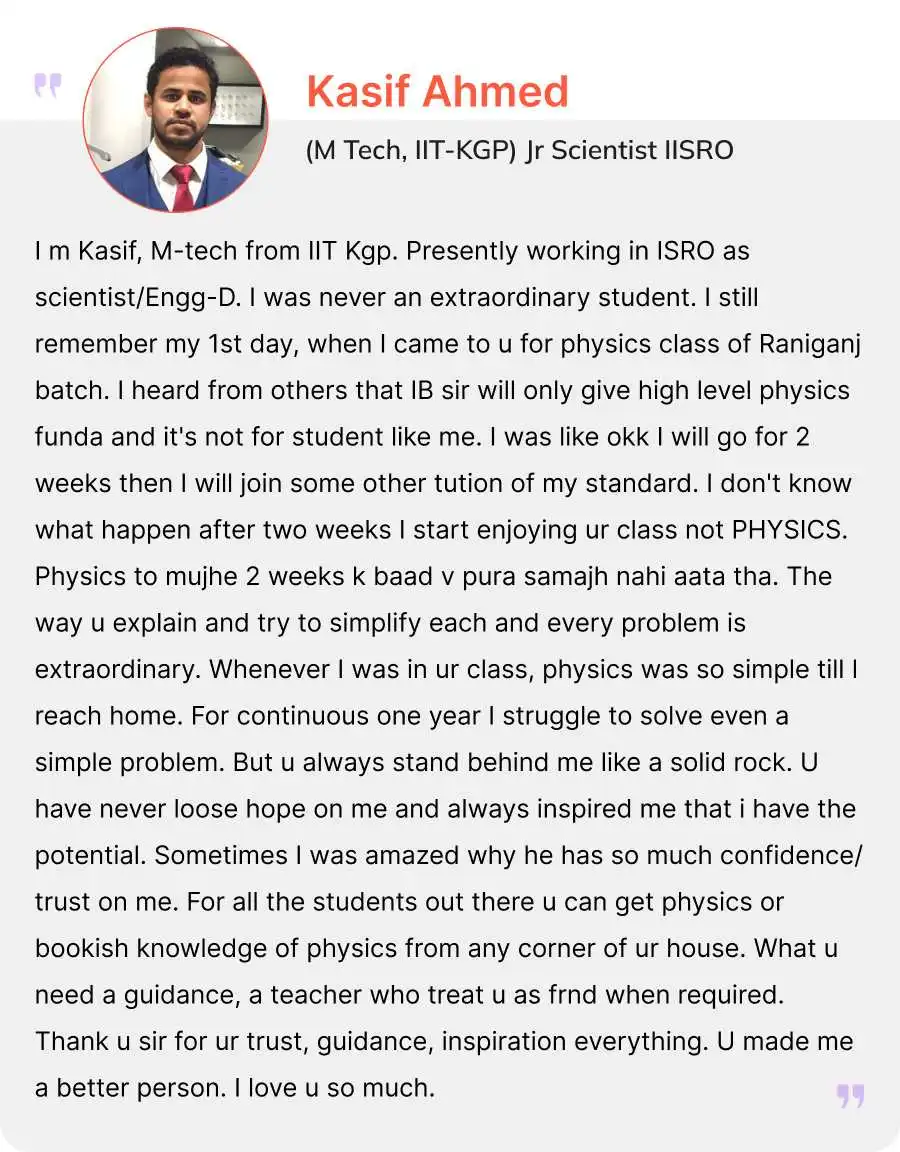
Physics can feel like a brain teaser that never ends — especially mechanics and optics. Forces, motion, light rays- it’s easy to get lost in formulas without seeing what’s happening.
Study with IB, a physics coaching centre for JEE in Kolkata, uses 3D animations and simulations to help students visualise concepts in real time and connect theory with practice.
Let this blog guide you through how these innovative tools are transforming the way students master mechanics and optics.
The Challenge of Learning Mechanics and Optics
Mechanics and optics are two of the trickiest topics in JEE physics. Many students find themselves staring at formulas and diagrams, wondering how forces move or how light behaves.
This disconnect often makes learning frustrating and time-consuming, especially when traditional methods rely heavily on textbooks and static 2D diagrams.
Why Students Struggle
Students often face hurdles such as:
- Mechanics: Understanding vectors, forces, and motion equations.
- Optics: Grasping reflection, refraction, interference patterns, and lenses.
- Traditional learning limits: Static diagrams and text-heavy explanations fail to show concepts in motion.
These challenges make it hard to visualise problems, leading to confusion and slow progress.
The Rise of Interactive Learning Tools
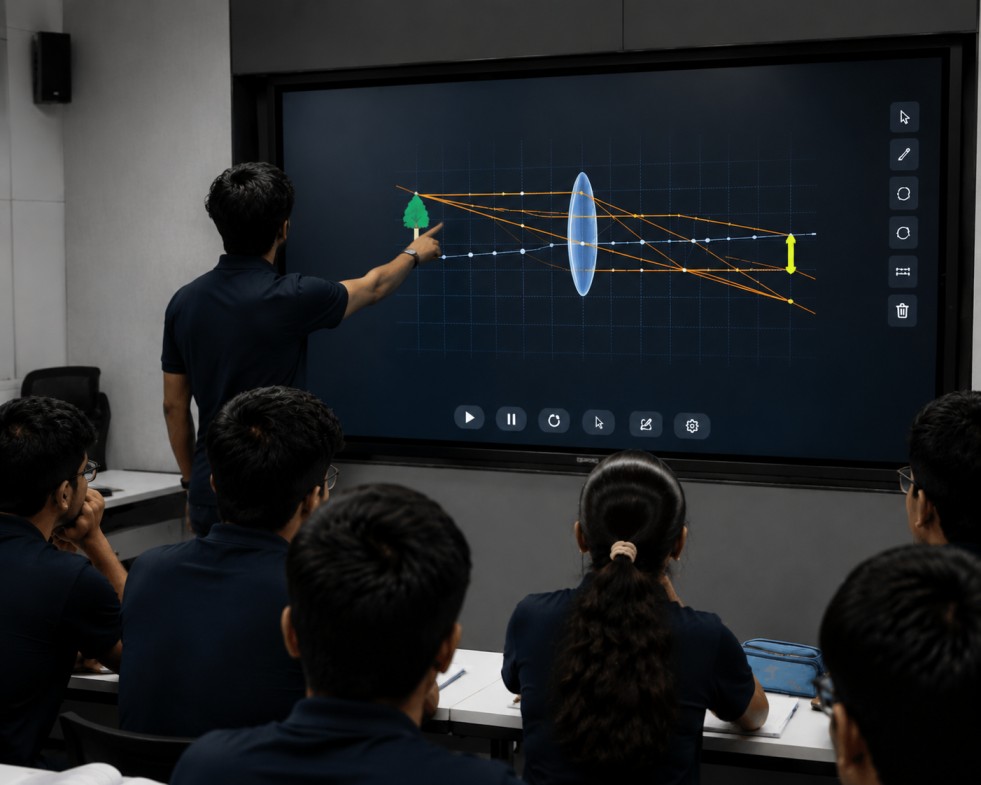
With traditional teaching methods often falling short, interactive learning tools have emerged as game-changers in physics coaching.
Today’s top JEE centres are moving beyond textbooks and static diagrams, introducing 3D animations and simulations that allow students to see physics in action. These tools turn abstract concepts into visual, manipulable models, making it easier for students to grasp challenging topics in mechanics and optics.
What Are 3D Animations and Simulations?
3D animations and simulations are digital models that illustrate trajectories, forces, and light paths in real time.
Basic advantages include:
- Real-time visualisation: observe motion, collisions, and optical effects as they happen.
- Interactive experimentation: students can change variables like mass, velocity, or angles to see immediate effects.
- Better conceptual understanding supports visual physics learning for engineering entrance exams.
Why Top JEE Coaching Centres Are Adopting Them
Leading centres use these tools because they:
- Enhance conceptual clarity and strengthen problem-solving skills.
- Boost student engagement and confidence through interactive lessons.
- Align with immersive physics simulations for mechanics, helping students connect theory with practical application.
By integrating 3D simulations, coaching centres ensure that learning becomes more intuitive, engaging, and exam-ready.
At Study with IB in Kolkata, a physics coaching centre for JEE, IB Sir ensures that students master every concept using these innovative methods.
Benefits of Using 3D Tools in JEE Physics Coaching
Modern 3D animations and simulations are transforming how students approach mechanics and optics. By moving beyond static diagrams, these tools make abstract physics concepts tangible, turning confusion into clarity.
For JEE aspirants, this means faster learning, fewer mistakes, and a deeper understanding of core principles.
| Benefit | How 3D Tools Help Students |
| Faster Concept Mastery | - Abstract concepts become visible and interactive.- Students grasp motion, forces, and light behavior quickly.- Semantic tie: JEE physics coaching with 3D animations and simulations links theory with practical understanding. |
| Better Retention and Accuracy | - Visual learning reduces formula forgetting.- Step-by-step animations minimize calculation errors.- Repeated simulations reinforce memory and problem-solving skills. |
| Increased Engagement and Confidence | - Learning becomes fun and interactive, reducing fear of complex topics.- Encourages self-paced exploration and experimentation.- Students gain confidence by visualizing outcomes and testing hypotheses. |
How 3D Animations Transform Mechanics Lessons
Mechanics can be one of the most abstract and challenging topics for JEE aspirants. Concepts like projectile motion, circular motion, and Newton’s laws often seem easy on paper but are hard to visualize in real life.
This is where 3D animations and simulations step in, turning theoretical problems into interactive, dynamic learning experiences. Students are no longer limited to static diagrams—they can
- Now see forces in action,
- Manipulate variables, and
- Understand the “why” behind every motion
| Focus Area | How 3D Animations Help |
| Visualising Motion and Forces | - Animations make concepts like projectile trajectories, circular motion, and Newton’s laws tangible.- Students can adjust mass, velocity, angles, or force vectors to see real-time changes.- Hands-on exploration helps internalize concepts faster than rote memorization. |
| Solving Complex Problems Faster | - Step-by-step visualizations reduce calculation errors by showing how forces interact over time.- Students can simulate scenarios repeatedly to reinforce correct approaches.- Semantic tie: physics problem solving with digital simulations ensures connection of theory to application. |
| Real-Life Application Demonstrations | - Simulations link classroom theory to practical scenarios like roller coasters, engineering machines, vehicle dynamics, and everyday motions.- Seeing real-world applications helps students understand why a principle works, not just how.- Connects abstract physics to tangible experiences, boosting confidence and conceptual clarity. |
Making Optics Intuitive with Digital Models
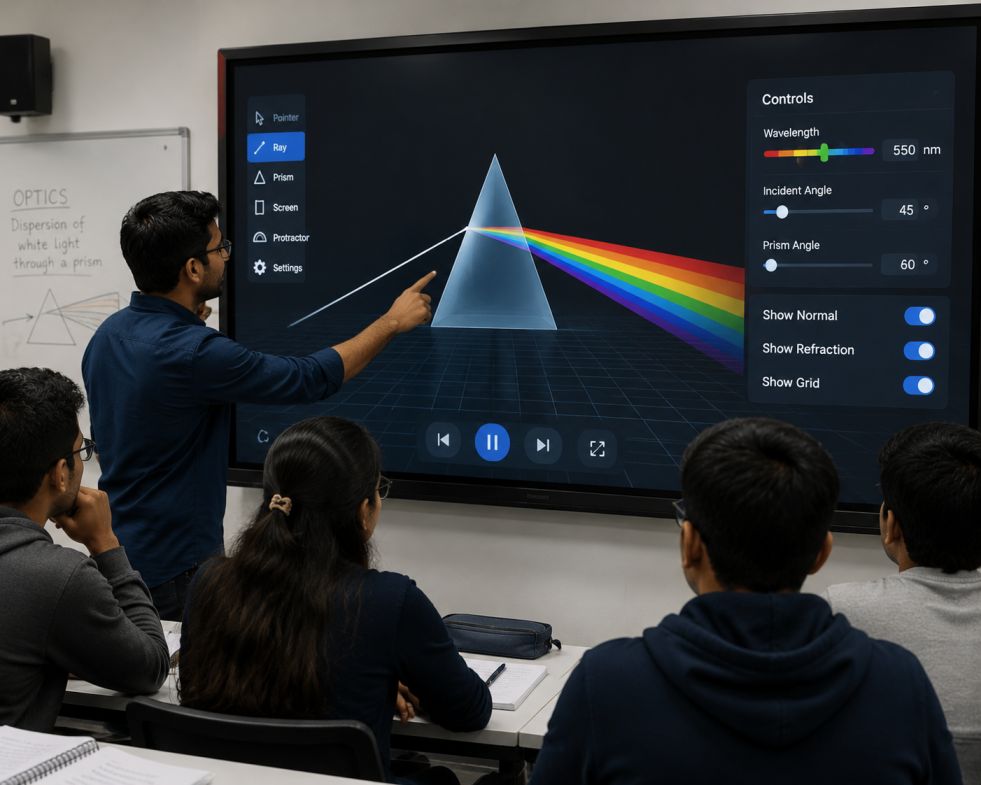
Optics is often one of the most abstract topics for JEE aspirants. Understanding how light bends, reflects, or interferes can be tricky when relying solely on static diagrams in textbooks.
This is where digital models and 3D animations make a difference. By turning theoretical ideas into interactive visualisations, students can actually see how light behaves, making learning faster, clearer, and more intuitive.
Light Behavior in Action
- 3D visualisations demonstrate refraction, reflection, dispersion, and interference in real time.
- Students can observe lenses and mirrors from different angles, improving spatial understanding.
- These tools provide a hands-on approach that bridges abstract theory with visual clarity, acting as visual learning tools for complex physics concepts.
Interactive Experiments
- Students can safely simulate optics experiments that would normally require a lab.
- Immediate results provide instant feedback, allowing them to experiment with variables like angle of incidence or lens curvature.
- Semantic tie: optics learning using digital models and animations ensures concepts stick.
Connecting Theory with JEE Problems
- Simulations can be mapped to previous JEE questions, helping students recognize patterns and anticipate tricky scenarios.
- This approach reinforces problem-solving skills while keeping abstract concepts tangible.
- By combining theory, practice, and visualisation, students gain confidence and clarity, improving both understanding and performance in exams.
Visual Learning Tools to Ace JEE Physics Faster
Physics concepts in mechanics and optics can be abstract and challenging for JEE aspirants, but 3D animations and simulations make learning interactive, visual, and engaging. Students can see motion, forces, and light behavior in real time, experiment safely, and connect theory with practical applications.
Study with IB, a physics coaching centre for JEE in Kolkata, where IB Sir provides expert guidance using these innovative methods.
Take the first step—call +91 9474114212 to enroll today.
People Also Ask
- How do 3D animations help students understand mechanics and optics?
3D animations make abstract concepts like motion, forces, and light behavior visible in real time. Students can manipulate variables and see outcomes, which strengthens understanding and retention.
- In what ways do 3D animations simplify physics for JEE aspirants?
By turning complex formulas into interactive visuals, 3D animations simplify problem-solving and concept grasping. This approach reduces confusion and builds confidence for exams.
- Why are simulations more effective than traditional physics diagrams?
Simulations show concepts in action rather than static images, allowing students to experiment and observe results instantly. This hands-on approach enhances clarity and practical understanding.
- Can interactive 3D tools improve problem-solving speed and accuracy for JEE?
Yes, step-by-step simulations reduce calculation errors and help students practice efficiently. Repeated interaction with concepts boosts both speed and precision in exams.
- What are the benefits of using visual learning tools for complex physics concepts?
Visual learning tools make abstract topics tangible, improving retention and engagement. They allow students to experiment safely and connect theory with real-world applications.