

The Center of Mass (COM) is the balance point where all of an object's mass can be considered concentrated. For irregular objects in NEET, COM can be calculated using sections, the plumb-line method, or integration.
This blog will teach step-by-step methods, exam tricks, and strategies to master irregular object COM problems.
What is the Centre of Mass?
In NEET Physics, the concept of centre of mass is fundamental. The centre of mass (COM) is the point where the total mass of a system or object can be considered to be concentrated.
Understanding COM is crucial because it connects systems of particles and rotational motion to NEET topics.
For NEET aspirants, mastering COM is a high-yield skill that appears repeatedly in NCERT rotational motion problems and NEET PYQs on the centre of mass.
Points to remember:
- COM represents an average weighted position of mass.
- For symmetric objects, COM aligns with the geometric center.
- In irregular shapes, COM shifts toward heavier sections.
Example:
For a rod of length (L) with mass (M) and a small mass (m) attached at one end, the COM is closer to the larger mass, not at the midpoint.
How COM Differs for Irregular Objects
Irregular shapes, such as L-shaped plates or rods with uneven masses, require special attention. Irregular body COM calculations involve:
- Breaking the object into simple shapes
- Assigning a coordinate system for each section
- Using the weighted average formula to find the COM
Ignoring these steps often leads to errors in moment of inertia and COM questions, a common pitfall in NEET exams.
Core Concepts Every NEET Aspirant Must Master
Before attempting problems, NEET aspirants should clearly understand the physics principles behind COM. This section mixes conceptual clarity with exam-ready strategies.
Formulas & Intuition
Mastering these formulas ensures quick problem-solving:
- Two-particle system
- Continuous mass distribution
- Moment of inertia relation
Tips for NEET preparation:
- Use symmetry wherever possible
- Check your units after calculation
- Always cross-verify the COM location with physical intuition
Important Physics Principles Linked to COM
- Translational motion vs center of mass motion: Objects move as if mass is concentrated at the COM.
- Rotational effects in irregular objects: Angular momentum and stability depend on the COM location.
- COM in equilibrium: For an object to be balanced, the line of action of weight must pass through the base of support.
At Study with IB, the NEET Physics coaching in Kolkata, IB Sir provides practical tips and guidance for students. These strategies will help you master challenging concepts like irregular objects and centre of mass effectively.
Table for Quick Reference
COM Positions for Common Irregular Objects (NEET Focus)
| Object Type | COM Location | NEET Exam Tip |
| L-shaped plate | Towards longer/heavier segments | Break into rectangles |
| Uniform rod with point mass | Weighted average along axis | Assign coordinates |
| Thin plate with cut-out | Shifted from the geometric center | Use symmetry for the missing part |
Step-by-Step Approach for Solving COM Problems (NEET Focus)
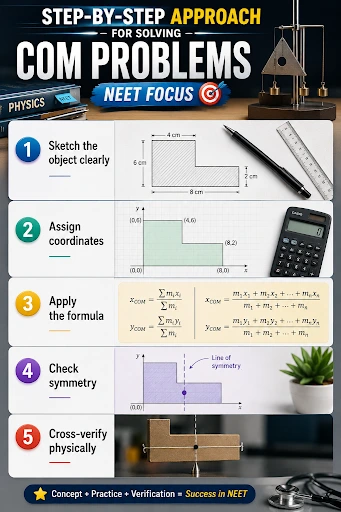
Tackling irregular objects' centre of mass problems becomes easier with a systematic approach.
The following steps help avoid errors and save time during exams.
Step-by-step guide for NEET aspirants:
- Sketch the object clearly: Break irregular shapes into simpler geometric sections.
- Assign coordinates: Choose a reference axis and mark (x, y) (and (z) if needed) positions for each section.
- Apply the formula: Use the centre of mass formula and examples to calculate each coordinate of the COM.
- Check symmetry: Use symmetry to simplify calculations wherever possible.
- Cross-verify physically: Ensure the COM location makes sense; heavier parts pull the COM toward them.
Quick Exam Tip:
Always label masses and lengths in your diagram; it prevents mix-ups in multi-component problems.
Common NEET Mistakes & How to Avoid Them
Even students who know the formulas often lose marks due to small mistakes. Here’s what to watch for:
- Confusing the geometric center with the COM for irregular objects
- Ignoring mass weighting in composite systems
- Sign errors in vector addition (especially with negative coordinates)
- Forgetting to check units or convert them properly
Pro Tip: Practicing NCERT rotational motion problems repeatedly ensures you internalize these checks and boosts confidence for NEET.
Past Year Papers and Question Pattern
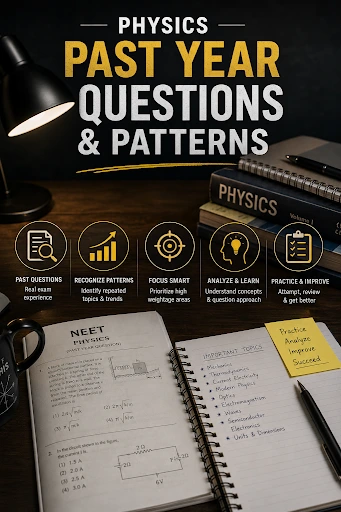
Analysing past years' questions is part of scoring high. Most NEET COM questions test your understanding of translational and rotational motion, irregular body calculations, and problems involving systems of particles.
NEET PYQs – COM Questions (Last 5 Years)
| Year | Topic Focus | Difficulty | Key Learning |
| 2021 | COM of particle system | Medium | Vector addition & weighted averages |
| 2022 | COM in irregular shape | High | Break into components & apply the formula |
| 2023 | Translational motion COM | Easy | Direct application of the COM formula |
| 2024 | Rotational motion & COM | High | Link with the moment of inertia |
| 2025 | Mixed conceptual | Medium | Multi-concept integration |
How PYQ Analysis Boosts NEET Scores
- Understand the type of COM problem most frequently asked
- Recognize the pattern of mark allocation in rotational and translational motion questions
- Focus on high-yield irregular object COM questions to maximize score
- Integrate NCERT problem-solving strategies with past-year questions for exam readiness
Exam Insight: Students who combine formula mastery with PYQ practice often see a 10–15% score improvement in Physics.
Visualising Centre of Mass – Real-World Examples That Help You Score
Understanding COM in abstract problems is one thing, but visualising it in real objects helps you apply formulas faster during NEET exams.
Examples of COM in Irregular Bodies
| Object | COM Location | NEET Tip |
| L-shaped plate | Towards longer/heavier segments | Divide into rectangles, calculate weighted COM |
| Uniform rod with attached mass | Closer to heavier mass | Assign coordinates along the axis |
| Thin plate with cut-out | Shifted from the geometric center | Use symmetry to simplify the calculation |
| Hanging an irregular pendulum | Slightly below the suspension point | Helps in rotational motion questions |
| Composite block of two materials | Closer to the denser part | Treat each material separately |
Quick recall:
- COM always lies towards the heavier sections in irregular objects.
- Symmetry shortcuts can save time during exams.
- Practice sketching real-life examples to visualise COM locations quickly.
Practice Sets & Must-Do NEET Questions
Hands-on practice is crucial. Here are 5 high-yield questions for NEET aspirants:
5 Must-Do Practice Questions
- Calculate the COM of two unequal masses placed along a uniform rod.
- Determine the COM of an L-shaped thin plate using coordinate decomposition.
- COM calculation for a rod with a small attached mass at one end.
- Predict COM for a composite object made of two materials of different densities.
- Solve a translational motion problem where the COM moves along a line under external forces.
Pro Tips:
- Sketch each object and mark the axes clearly
- Break irregular objects into smaller, manageable shapes
- Check results by asking if the COM lies toward the heavier portions
Boost Your NEET Physics Score – Strategic Tips
Scoring high on COM and systems of particles and rotational motion NEET problems requires more than formulas:
How a Structured Coaching Approach Helps
- Targeted practice on irregular objects & rotational topics
- Mentor feedback on common mistakes
- Regular timed tests to simulate NEET exam conditions
- Personalised guidance to strengthen weak areas
Master Centre of Mass & Beat the NEET Cutoff
By focusing on irregular body COM calculations, understanding systems of particles and rotational motion, and practicing NCERT rotational motion problems along with NEET PYQs on the centre of mass, students can dramatically improve their NEET Physics scores.
For students preparing for NEET, Study with IB, the trusted NEET Physics coaching in Kolkata, provides expert mentorship, high-yield strategies, and structured practice for tough topics.
Enroll now to secure your spot and boost your NEET preparation.
Call +91 9474114212 today
People Also Ask
- Why is the center of mass different for irregular objects compared to regular ones?
Irregular objects have uneven mass distribution, so the COM shifts toward heavier sections. Regular shapes have the COM at the geometric center. - Can the center of mass lie outside the physical body of an object?
Yes, in hollow or L-shaped objects, the COM can be outside the material, which affects balance and rotational motion problems. - How does the COM affect stability and balance in irregular shapes?
An object is more stable when its COM is low or centered; a high or offset COM increases the chance of tipping. - What shortcuts or tricks can save time while solving COM problems in exams?
Use symmetry to simplify calculations, label all masses/lengths, sketch diagrams, and verify the COM location physically. - How do past NEET questions test irregular body COM concepts?
NEET questions focus on translational and rotational motion and composite objects. Practicing past-year questions highlights patterns and high-yield problem types.