Physics chapters look familiar in both exams. Should preparation look the same? This question matters in Classes 11 and 12. If a student is choosing a physics tuition centre for JEE, check how its teaching matches their goal. To clear all doubts, we’ve explained NEET vs JEE physics and what each paper expects. By the end, students and parents will know exactly which preparation style suits their goal. The blog covers:
- Syllabus overlap and question styles.
- Difficulty, exam patterns and preparation.
- Choosing the path that fits your interests.
Is Physics Different for NEET and JEE?
Yes. The core chapters overlap, but question depth and expectations differ. NEET generally emphasises clear concepts and efficient calculations. JEE Main tests application; JEE Advanced demands more complex reasoning. The practical difference between NEET and JEE physics lies mainly in how you apply shared ideas. Build that foundation, then adapt your practice.
What Is the Difference in the NEET and JEE Physics Syllabus?
The NEET physics syllabus and JEE Main physics syllabus share mechanics, thermodynamics, electrostatics, current electricity, optics and modern physics. NEET follows Class 11 and 12 NCERT closely, but the official syllabus remains your checklist. Both also include experimental skills. We recommend these practice priorities:
| Topic | NEET approach | JEE approach |
| Mechanics | Concepts and standard numericals | Linked concepts and mathematical reasoning |
| Heat and electricity | Laws, graphs and calculations | Applications involving several steps |
| Optics | Diagrams and sign conventions | Geometry and combined applications |
| Modern physics and semiconductors | Focused conceptual revision | Main: concepts and numericals; check Advanced separately |
Please note: Modern physics and semiconductors can be useful revision targets; no official chapter weightage guarantees marks. Advanced has its own topic list. Check the latest official syllabuses before planning the revision.
How Do the Physics Exam Patterns Differ?
These are the 2026 standard exam patterns. JEE Main’s 2027 bulletin retains the same structure.
| Exam | Physics questions | Marking | Full exam duration |
| NEET | 45 single-correct MCQs | +4 correct; −1 wrong; 0 skipped | 180 minutes |
| JEE Main | 20 MCQs + 5 numerical-value questions | +4 correct; −1 wrong in both types; 0 skipped | 180 minutes |
| JEE Advanced | 16 in Paper 1; 18 in Paper 2 | Section-specific; partial and negative marks apply selectively | Two papers, 180 minutes each |
Always remember: NEET has 180 questions overall; JEE Main has 75. Neither reserves separate time for physics. While JEE Advanced includes multiple-correct, numerical and matching or linked questions, so read each section’s marking rules.
Which Is Tougher: NEET Physics or JEE Physics?
So, which is tougher: NEET or JEE? We find that JEE physics generally requires deeper mathematical reasoning, especially in Advanced. NEET puts pressure on speed and accuracy across three subjects. Papers vary, so this is a broad comparison.
The NEET vs JEE physics difficulty level also depends on a student’s calculation skills. Biology-focused students may find turning words into equations unfamiliar. At Study with IB, we use regular tests to identify individual weaknesses. A wrong answer needs diagnosis: was the problem a weak concept, algebra or careless reading? That distinction guides what to practise next.
How Should You Prepare for NEET Physics vs JEE Physics?
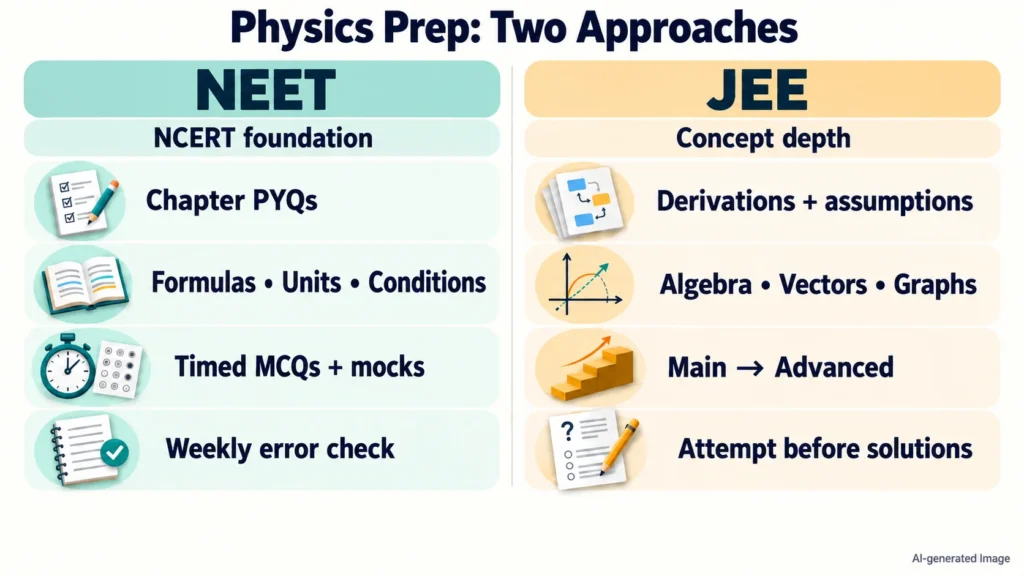
NEET Physics Preparation Approach
Our NEET physics preparation strategy starts with NCERT, followed by:
- Previous-year questions after each chapter.
- Formula recall, including units and conditions.
- Timed MCQ sets and full-paper practice.
- An error notebook, reviewed weekly.
JEE Physics Preparation Approach
Our JEE physics preparation strategy adds depth:
- Understand derivations and assumptions.
- Strengthen algebra, vectors and graphs.
- Progress from Main questions to Advanced problems.
- Attempt unfamiliar problems before reading solutions.
Please note: For JEE physics vs NEET physics preparation, learn shared concepts once, then use separate practice sets. If preparing for both stretches the schedule, keep one primary target.
Which Exam Should You Choose Based on Your Strengths?
NEET or JEE: which to choose after 12th? We recommend starting with your career goal:
- NEET: medical ambitions and sustained interest in biology.
- JEE: engineering ambitions and enjoyment of maths and applications.
Both require conceptual understanding. We recommend checking subject eligibility and course demands before choosing; an easier physics paper cannot decide your career.
Match Your Preparation to Your Goal
The chapters overlap; the practice must suit the exam. We help students connect clear concepts with the right question sets if you’re looking for a physics coaching centre for JEE in Kolkata. We also offer NEET physics coaching. It all depends on the exam students are preparing for, their goals, current marks, and preparation gaps. Contact us or visit us for counselling!
What People Also Ask
Is NEET physics easier than JEE physics?
Generally, NEET physics involves less complex mathematical reasoning than JEE Advanced. JEE Main varies by shift and includes some direct questions. NEET still requires strong concepts and fast calculations, so an easier question level doesn't automatically mean an easier score.
Is it possible to prepare for NEET and JEE physics together?
Yes. Learn overlapping concepts together, then practise questions suited to each exam. NEET needs timed MCQs, while JEE requires varied applications and numerical answers. Preparing for both exams also means managing biology and mathematics, along with checking eligibility for each.
Is NCERT enough for NEET physics?
NCERT is the starting point for concepts, examples and diagrams. Reading it alone is unlikely to provide enough practice with calculations. Add previous-year NEET questions, syllabus-aligned exercises and timed tests, then return to the textbook whenever mistakes reveal a gap in understanding.
Is NCERT enough for JEE physics?
NCERT builds the foundation, but most students need additional problem-solving practice for JEE Main and Advanced. Use previous-year papers and a suitable graded problem set. Understand why a method works, rather than collecting books or memorising the steps in solved examples.
Which has more physics numericals, NEET or JEE?
There is no fixed official count of calculation-based questions in NEET. Its MCQs can include numericals. JEE Main explicitly includes five numerical-value physics questions, but its MCQs can also require calculations. Answer format and calculation demand are different things to compare.
How many physics questions come in NEET and JEE Main?
Under the 2026 pattern, NEET has 45 physics questions, all single-correct MCQs. JEE Main Paper 1 has 25: 20 MCQs and five numerical-value questions. The published JEE Main 2027 bulletin retains this distribution. Check the bulletin for your own examination year.
Is the physics syllabus the same for NEET and JEE?
NEET and JEE Main overlap substantially in Class 11 and 12 physics, but students should compare the official topic lists for their examination year. JEE Advanced publishes a separate syllabus. Similar chapter names do not guarantee identical coverage or question depth.
[H3] Which physics chapters are common to NEET and JEE?
Common areas include mechanics, thermodynamics, electrostatics, current electricity, magnetism, optics, waves and modern physics. Measurement and experimental topics also matter. Use these shared areas to build a common foundation, then check individual subtopics and practise at the level a target requires.
Can a student switch from JEE to NEET preparation in Class 12?
Yes, if the student meets NEET’s subject and other eligibility requirements. Physics and chemistry preparation can help, but biology needs substantial study. Check qualifying subjects, practical requirements, and the time available before switching. Strong JEE physics preparation alone does not establish NEET eligibility.
How many hours should a student study physics daily for NEET/JEE?
There is no compulsory daily number. A practical starting point is 90–120 focused minutes outside classes, adjusted around schoolwork and other subjects. Divide that time between concepts, questions, and error review. Increase or reduce it based on progress, sleep, and upcoming tests.