
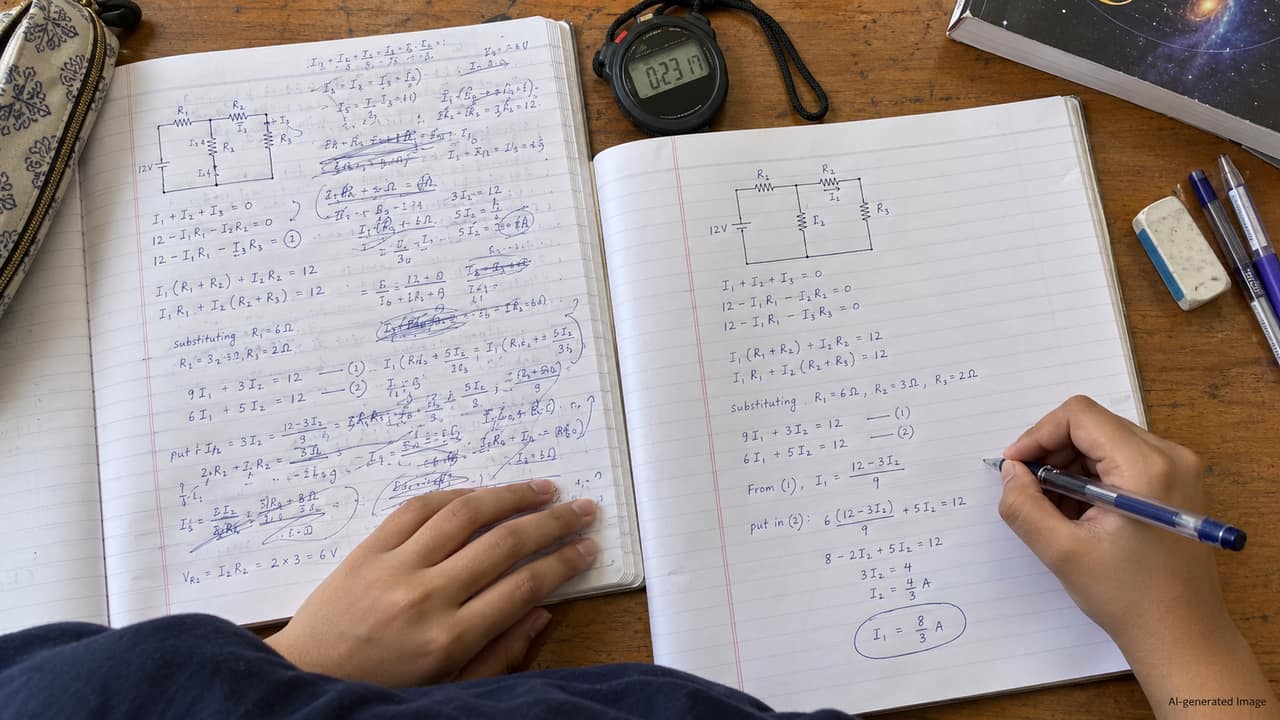
A student remembers the formula but loses time converting units. Another calculates quickly but misses a negative sign. Knowing the chapter and solving questions efficiently are different skills.
At Study with IB, we connect concepts with practical problem-solving. Learning how to solve physics numericals faster takes deliberate practice. These seven methods help Class 11 and 12 students and NEET/JEE aspirants build that skill.
The blog covers:
- Seven methods with worked examples.
- A daily routine and four-week plan.
- Exam habits that protect time and accuracy.
Why Do Students Take So Long to Solve Physics Numericals?
Students often lose time before calculating. Common reasons include:
- Weak concepts: choosing a formula without understanding the situation.
- Slow arithmetic: struggling with fractions, powers or conversions.
- Poor reading: missing words such as “smooth” or “from rest”.
- Uncertain recall: repeatedly searching for the right equation.
- Over-checking: restarting a correct solution without finding an error.
A student may know the formula but forget to convert 72 km/h to 20 m/s before calculating. That small oversight can lead to an incorrect answer and time spent rechecking the solution. We recommend fixing these recurring errors before doing more practice questions.
What Are the 7 Tricks to Solve Physics Numericals Faster?

Useful physics numerical tricks help you keep your reasoning correct. These tips for solving physics numericals in competitive exams work best once you understand the concepts.
Can Understanding the Concept First Save Time?
Yes. Learning how to solve physics problems quickly starts with identifying the situation. Is current shared, energy conserved or acceleration constant? This narrows the equations worth considering. Students should state the governing idea before calculating; it also helps with unfamiliar questions.
Let’s Learn Through an Example: Two resistors, 2 Ω and 4 Ω, are connected in series across an ideal 12 V source. Their resistances add, so current I = 12 ÷ (2 + 4) = 2 A.
How Do Units and Dimensional Analysis Help Check Answers?
Units expose mismatched quantities and incorrect expressions, especially when MCQ options contain formulas. However, dimensional agreement cannot prove an equation correct or distinguish expressions differing only by a numerical factor.
Example: A body starts from rest with constant acceleration a = 3 m/s² for t = 4 s. Speed v = at = 12 m/s. The expression at² gives metres, so it cannot represent speed.
Should Students Approximate Instead of Calculating Exactly?
Approximation offers useful physics shortcuts for NEET when options are well separated. Round sensibly, track powers of ten and retain precision when answers are close. Use g = 10 m/s² when specified; do not casually replace a given value of 9.8.
Example: For mass 2.02 kg and acceleration 4.98 m/s², force is approximately 2 × 5 = 10 N. That separates options of 1 N, 10 N and 100 N without lengthy multiplication.
How Can Drawing Diagrams Speed Up Problem Solving?
A sketch organises information before algebra. Free-body diagrams show forces and axes; ray diagrams establish image positions and signs. For students seeking physics shortcuts for JEE, a labelled diagram prevents solutions from being built on the wrong geometry.
Example: A 2 kg block slides freely down a frictionless 30° incline. Taking g = 10 m/s², the downhill force is mg sin 30° = 2 × 10 × ½ = 10 N.
Is It Better to Solve Symbolically Before Substituting Numbers?
Often, yes. Rearranging symbols reveals cancellations and proportional relationships, reducing repeated multiplication. For ratio questions, students can avoid calculating either original value. Substitute after identifying changing and constant quantities.
Example: Kinetic energy K = ½mv². If mass doubles and speed triples, K′/K = 2 × 3² = 18. The original mass, speed and factor ½ cancel.
How Can Students Quickly Eliminate Wrong MCQ Options?
Check signs, physical limits and extreme values. These checks remove impossible answers before detailed calculation. Conclusions must follow from stated conditions. Numerical-answer questions still require a calculated value.
Example: Two positive resistances, 6 Ω and 3 Ω, are connected in parallel. Their equivalent resistance must be below 3 Ω. Among 2, 3, 6 and 9 Ω, only 2 Ω survives.
How Does Timed Practice Improve Numerical Speed?
Timers expose delays. For physics time management in NEET, try a one-minute practice benchmark for familiar MCQs, then review errors. This is not a universal deadline; complex JEE problems need different targets. Spaced review and self-testing support retention.
Example: Find the momentum of a 100 g object moving at 20 m/s: p = 0.1 × 20 = 2 kg m/s. Note conversion or multiplication delays.
How Can Students Build Calculation Speed Daily?
Alongside chapter work, students asking how to improve speed in physics can use this 15-minute routine:
- Three minutes: multiplication tables, squares up to 25 and common fractions.
- Four minutes: unit conversions, powers of ten, approximation and relevant logarithm rules.
- Six minutes: three short numericals, attempted independently.
- Two minutes: correct one recurring mistake.
Four-week plan:
- Week 1: measure accuracy without rushing.
- Week 2: practise diagrams, units and symbolic cancellation.
- Week 3: introduce timed chapter sets.
- Week 4: use mixed sets and compare accuracy alongside time.
What Mistakes Slow Students Down in Physics Exams?
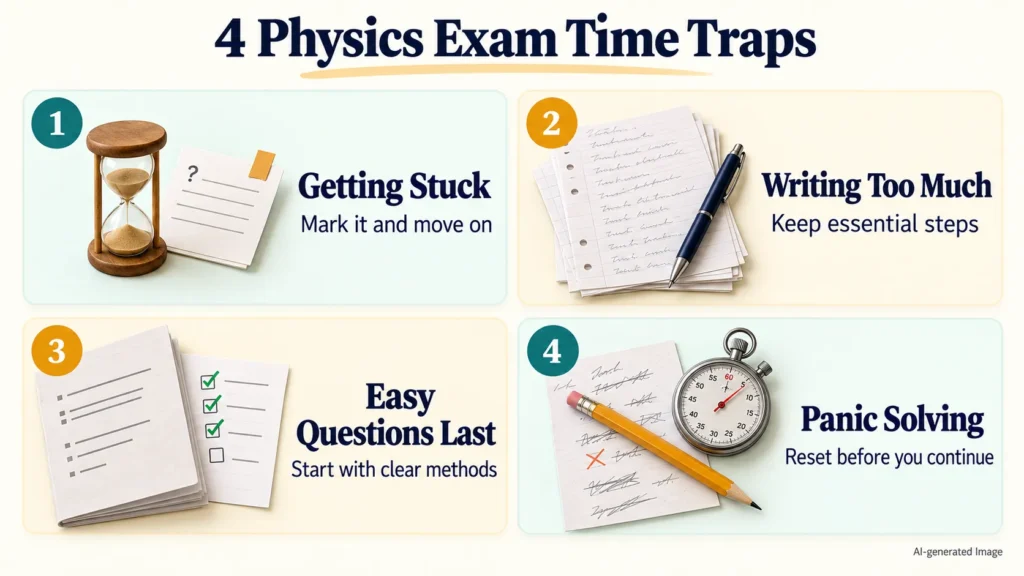
Students learning how to improve physics numerical solving should watch for:
- Spending too long on one difficult question.
- Rewriting every line of working.
- Leaving familiar questions until the end.
- Rushing after one unsuccessful attempt.
We recommend a first pass through manageable questions, then returning to marked problems.
Build Speed through Better Practice
For aspirants asking how to score high in NEET physics, accuracy must remain the priority. Try one method each week and track your progress. Thinking of NEET physics coaching in Kolkata? We help students strengthen concepts and exam technique. Download the Physics Speed Practice Sheet for a starting set and answer key.
What People Also Ask
How can students increase their speed in physics numericals?
Identify the slowest step, practise a shorter valid method and measure accuracy alongside completion time.
How many numericals should NEET/JEE aspirants practise daily?
Start with 10–15 carefully reviewed questions. Adjust the number to difficulty, available time and learning gaps.
How much time should students spend on one physics question in NEET?
Use roughly a minute for familiar practice MCQs; set the actual exam budget through full mocks.
Is it okay to use shortcuts in physics?
Yes, when the method follows valid physics and its assumptions match the question.
How can students reduce calculation mistakes in physics?
Convert units first, simplify symbols, retain necessary precision and check the final sign and unit.
Does dimensional analysis help in competitive exams?
Yes. It rejects inconsistent expressions, but cannot distinguish every pair of dimensionally correct answers.
How can students improve physics speed with weak maths skills?
Practise fractions, algebra, scientific notation and basic trigonometry through short, regular exercises.
Should students solve easy or hard physics questions first?
Start with questions whose methods are clear, then return to those requiring longer reasoning.
How can students stop forgetting formulas during exams?
Recall formulas without looking, explain their conditions and revisit them through spaced practice.
How long does improving numerical-solving speed take?
There is no fixed timeline. Review progress weekly; improvement depends on starting skills and consistent practice.