
Physics can feel overwhelming for NEET aspirants. Concepts get confusing, formulas slip your mind, and practice never seems enough. Parents worry, students stress, it’s a familiar scene.
The good news?
With the right plan, focused practice, and guidance from IB Sir, a NEET physics tutor in Kolkata, you can catch up, stay on track, and confidently tackle the Physics section.
This blog will guide you to a simple, step‑by‑step 3‑month roadmap. From understanding which chapters matter most to mastering formulas and practicing previous year questions (PYQs), everything is broken down so you know exactly what to do each month.
Let’s get started on turning Physics from a headache into a scoring strength.
NEET Physics Exam Pattern You Must Understand?
Understanding the pattern is like unlocking the cheat codes, not literal answers, but the strategy to ace the section.
Which are the high-weightage NEET physics chapters you must know?
Some chapters consistently pull more questions in NEET, and mastering them can give you a scoring edge.
| Chapter | Approx. Weightage | Why It Matters |
| Mechanics | Very High | The foundation for many competitive questions |
| Electrostatics & Current Electricity | High | Conceptual + numerical balance |
| Modern Physics | High | Short, doable questions |
| Optics | Medium | High accuracy potential |
| Thermodynamics | Medium | Tough but rewarding |
How to Decode NEET Physics Questions: Concept + Application?
NEET Physics isn’t about rote memorisation; it’s about thinking, applying, and connecting concepts.
Most questions test three main skills:
- Concept Understanding
This is the “why” behind the question. NEET wants you to understand the underlying physics idea, not just memorise formulas.
For example, when you see a question on Newton’s laws, it’s not just about recalling F=maF = maF=ma; it’s about knowing why a force produces acceleration in a specific direction.
- Numerical Application
This is the “how” part. Once you understand the concept, you need to apply it to calculations.
For instance, if a question gives mass, acceleration, and friction, you should be able to plug the values into the right formula and interpret the answer. Speed and accuracy in this step separate top scorers from the rest.
- Multi‑Concept Synthesis
NEET often mixes ideas from two or more chapters in one question.
For example, a problem may combine Electrostatics + Mechanics or Optics + Waves. To solve it, you need to connect different concepts logically, analyse the relationships, and figure out which formulas to use. This is where applied thinking shines.
Tip: Practising NEET Physics previous year questions (PYQs) helps you master all three skills simultaneously, understanding concepts, applying formulas, and connecting multiple topics.
What Should Your Month‑by‑Month NEET Physics 3 Month Study Plan Look Like?
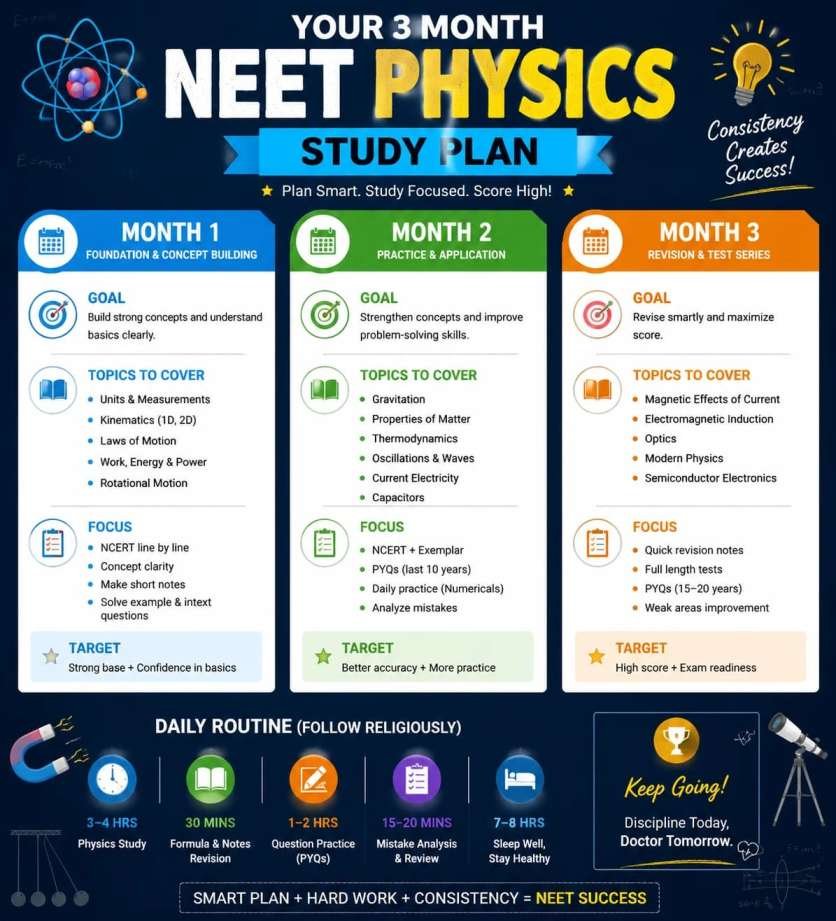
Here’s how to break down your time so every week feels like progress.
Month 1 — How Should You Build a Strong Foundation First?
Month 1 is foundational drilling concepts over cramming.
- Revise NCERT Physics chapters thoroughly.
- Create formula sheets.
- Solve basic questions.
- Use the NEET Physics syllabus breakdown month‑wise to target priority chapters.
Goal: Understand “why” behind every concept.
Month 2 — How Should You Boost Practice + Problem‑Solving Speed?
Now it’s time to attack.
- Solve topic‑wise tests.
- Time yourself.
- Use question banks + online mock tests.
Goal: Build accuracy and speed in solving application‑based questions.
Month 3 — How Should You Handle Revision + NEET Physics Previous Year Questions (PYQs)?
In the final month:
- Focus on the last 10 years of NEET Physics previous year questions (PYQs).
- Drill full‑length mock tests.
- Revise weak chapters daily.
Goal: Convert familiarity into confidence.
How Can You Master NEET Physics Concepts Faster?
To master NEET Physics concepts faster, focus on understanding the core principles rather than memorising formulas. Use active learning techniques like concept mapping, and reinforce your understanding with regular problem-solving practice.
What Are Smart Techniques for Remembering Formulas?
Effective NEET Physics formula revision techniques include:
- Breaking formulas into parts.
- Use flashcards for quick recall and practice regularly with mock tests.
- Daily revision sessions help reinforce formulas and ensure easy recall.
What Daily Consistency Hacks Actually Work?
To stay consistent with NEET Physics preparation, break study sessions into focused blocks.
- 25‑minute focused sessions (Pomodoro)
- Daily limit on distractions
- Tracking progress visibly
How Can You Boost Physics Problem-Solving Speed & Accuracy?
Two birds — speed and accuracy — need one stone: practice.
What Are Effective Problem‑Solving Strategies (No Guesswork)?
- Start with NCERT‑aligned questions.
- Break solutions into steps.
- Know when to skip and revisit later.
Avoid wild guessing: learn productive elimination.
What Time Management Tips Work During the NEET Physics Section?
- Attempt easy questions first
- Don’t linger more than 2 mins on a problem
- Mark for review and move on
Why Do Students Need a Tutor — What’s the Role of Guidance?

Self-study forms the foundation of NEET preparation, but it often falls short when tackling complex physics concepts. A tutor’s guidance provides a deeper understanding, helping students break down difficult topics and apply concepts effectively. With personalised support, students can boost their confidence, sharpen their problem-solving skills, and manage exam stress.
What Does a Top NEET Physics Tutor Bring to the Table?
A strong NEET Physics tutor brings much more than just subject knowledge to the table. They offer:
- Concept Clarification: They break down complex concepts into simpler, easy-to-understand ideas, allowing students to grasp them quickly.
- Effective Shortcuts: Experienced tutors introduce time-saving techniques and shortcuts that help students solve problems faster.
- Feedback and Accountability: Regular feedback and progress tracking help students stay on track, identify weak areas, and make necessary improvements.
Centres like Study with IB in Kolkata where under the guidance of IB Sir, a NEET physics tutor, have transformed weak areas into scoring zones for many aspirants.
How Should You Wrap Up Your Roadmap to Crush NEET Physics?
Cracking NEET Physics is all about the right approach. With a solid 3‑month plan, you can tackle concepts, improve speed, and refine accuracy. Focus on NEET Physics previous year questions (PYQs) to familiarise yourself with the exam. Set aside time for theory in the mornings and practice in the afternoons.
And if you need expert guidance from IB Sir, a NEET physics tutor in Kolkata can help you sustain momentum and eliminate confusion.
Join Study with IB today.
For admission-related queries, contact +91 9474114212
People Also Ask
- How can an effective 3‑month study plan for NEET Physics be created?
Divide the syllabus into manageable sections and focus on high-weightage topics. Allocate time each day for theory learning, practice, and regular revision.
- Which NEET Physics concepts should be prioritised in 3 months?
Start with Mechanics, Electrostatics, Thermodynamics, and Modern Physics chapters. In the final month, focus on Optics, Waves, and solve the previous year's questions.
- How many hours a day should be dedicated to NEET Physics preparation?
Study for 4–6 focused hours each day, ensuring consistent learning. Split your time for concept mastering, problem-solving practice, and revision.
- Should focus be on NEET Physics formulas or conceptual understanding?
Focus on understanding the core concepts first, then revise formulas. Both conceptual clarity and formula mastery are essential for tackling NEET Physics.
- Can coaching improve NEET Physics preparation effectively?
Coaching can offer structured guidance, personalized feedback, and strategic planning. It helps refine problem-solving techniques, boosting confidence and exam readiness.