JEE preparation isn't just about working hard; it's about working smart.
Many aspirants burn the midnight oil, but still struggle to improve their scores. The issue often lies not in effort but in the common mistakes that get overlooked.
Don’t worry.
These mistakes can be tackled early with the right strategy and expert guidance. We’ve identified the top 10 mistakes JEE aspirants tend to make, and in this blog, we’ll show you exactly how to fix them before they affect your performance.
We’ll take a look at the frequent mistakes JEE aspirants make and how to overcome them.
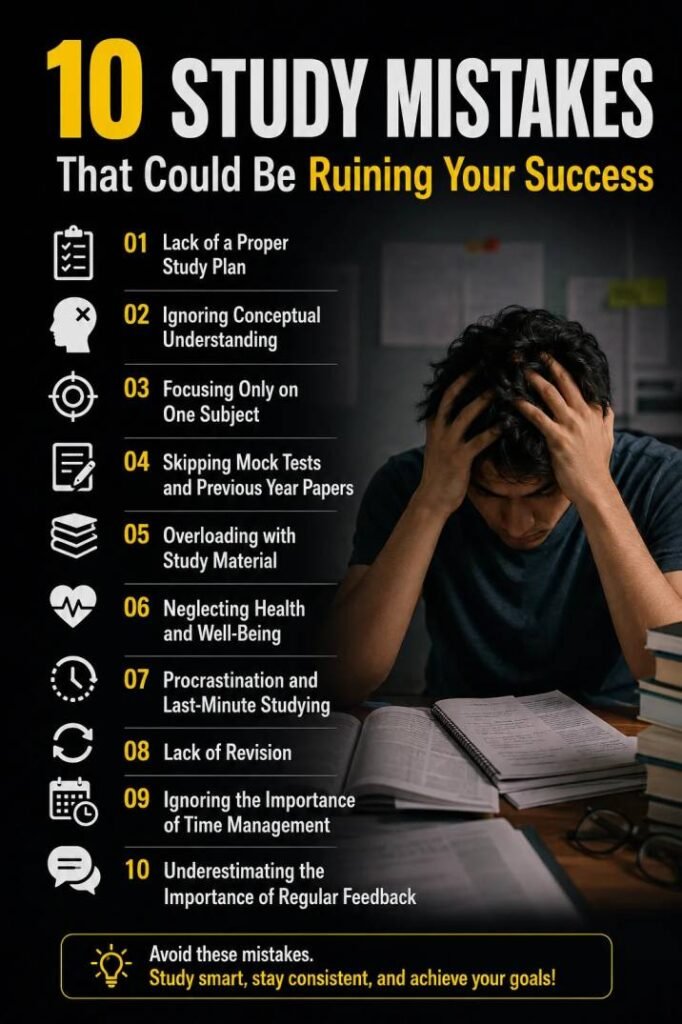
H2: 1. Lack of a Proper Study Plan
Creating a detailed study plan ensures consistent progress and focused learning. Without it, you may find yourself scrambling to cover everything at the last minute.
H3: Study Plan
| Importance | Benefits | Impact | Example | Mistake Avoided |
| Provides structure and focus | Reduced confusion | Efficient learning | Design a timetable with subject-wise time slots | Avoiding disorganised studying |
| Helps track progress | Keeps you motivated | Ensures no topic is missed | Break the syllabus into small chunks | No topics left behind |
| Ensures balanced study | Balanced performance | Reduces stress | Allocate study time for all subjects | Skipping subjects |
| Prevents burnout | Helps maintain consistency | Helps retain more info | Set small, achievable goals | Exhausting yourself too soon |
H2: 2. Ignoring Conceptual Understanding
Understanding the concepts is important to solve complex problems, especially in Physics and Chemistry. Without a solid grasp of the basics, no amount of rote learning will help you crack the toughest questions.
H3: Study Plan Tip
| Importance | Benefits | Impact | Example | Mistake Avoided |
| Provides deeper insight | Enhances problem-solving | Long-term retention | Use mind maps to understand concepts | Memorisation without understanding |
| Clarifies fundamentals | Makes advanced topics easier | Better application of concepts | Watch videos for visual learning | Blindly memorising formulas |
| Encourages curiosity | Increases interest | Reduces fear of difficult topics | Break down complex problems | Avoiding tough topics |
| Helps in real-world applications | Builds practical knowledge | Better critical thinking | Apply concepts to real-world examples | Ignoring real-life applications |
H2: 3. Focusing Only on One Subject
While it’s easy to get stuck on one subject you enjoy, remember that JEE requires balanced preparation. Ignoring Chemistry or Mathematics will affect your overall score, even if you ace Physics.
H3: Study Plan Tip
| Importance | Benefits | Impact | Example | Mistake Avoided |
| Balanced preparation | Overall improvement | More consistent performance | Allocate 2 hours per subject every day | Skipping subjects |
| Reduces burnout from repetition | Keeps you engaged | Increases learning motivation | Vary subjects every few hours | Over-focusing on one subject |
| Builds strength across topics | Better performance across subjects | Prevents last-minute cramming | Mix Physics, Chemistry, and Math throughout the day | Skipping subjects you don’t like |
| Enhances problem-solving skills | Promotes comprehensive learning | Improves exam strategies | Rotate subjects to maintain freshness | Burnout from excess focus on one |
H2: 4. Skipping Mock Tests and Previous Year Papers
Mock tests and previous year papers are your secret weapons. They not only help you practice under exam conditions but also familiarise you with the question patterns, boosting your confidence for the big day.
H3: Study Plan Tip
| Importance | Benefits | Impact | Example | Mistake Avoided |
| Improves exam strategy | Familiarises you with the exam pattern | Reduces exam stress | Solve one mock test every week | Unfamiliarity with exam format |
| Enhances time management skills | Improves speed and accuracy | Helps maintain focus during the exam | Practice with a stopwatch | Missing time management practice |
| Provides self-assessment | Identifies weak areas | Prevents mistakes during the real exam | Review mistakes after each test | Ignoring mistakes |
| Builds exam confidence | Reduces exam anxiety | Boosts performance on exam day | Simulate exam conditions regularly | Cramming too much at once |
H2: 5. Overloading with Study Material
More books don’t always mean better results. Sticking to essential study materials like NCERT and trusted references helps you focus and avoid confusion. Don’t drown yourself in an overload of resources.
Instead of drowning in a sea of resources, consider joining a Physics Coaching Centre for JEE in Kolkata, such as Study with IB. With structured guidance and expert insights from IB Sir, you can streamline your preparation and maximise your learning efficiency.
H3: Study Plan Tip
| Importance | Benefits | Impact | Example | Mistake Avoided |
| Focuses your attention | Helps with retention | Reduces confusion and distraction | Stick to the NCERT and one reference book | Overburdening yourself with books |
| Prevents distraction | Makes concepts clearer | Improves subject mastery | Use study guides to focus on the main points | Just skimming through materials |
| Enhances conceptual clarity | Promotes deep learning | Leads to better understanding | Use reference books for concept explanation | Blindly memorising formulas |
| Reduces stress and anxiety | Helps maintain focus | Boosts exam performance | Get a few essential books and master them | Trying to cover everything at once |
H2: 6. Neglecting Health and Well-Being
JEE preparation can be intense, but neglecting your health will affect your focus and retention. Prioritise proper sleep, exercise, and a balanced diet to keep your body and mind sharp for those long study hours.
H3: Study Plan Tip
| Importance | Benefits | Impact | Example | Mistake Avoided |
| Keeps you energised | Improves mental clarity | Reduces burnout | Eat regular, healthy meals | Skipping meals and snacks |
| Enhances focus and concentration | Reduces distractions | Increases study efficiency | Take short, frequent breaks | Overworking without rest |
| Improves memory retention | Reduces stress and anxiety | Boosts exam performance | Exercise for 30 minutes daily | Ignoring physical health |
| Keeps you physically active | Improves sleep quality | Boosts energy levels for study | Get at least 7 hours of sleep every night | Fatigue leading to mental block |
H2: 7. Procrastination and Last-Minute Studying
Procrastination is the enemy of progress. Last-minute cramming only leads to stress and mistakes. Stick to a routine, stay disciplined, and give yourself ample time to prepare for each subject.
H3: Study Plan Tip
| Importance | Benefits | Impact | Example | Mistake Avoided |
| Provides structure | Keeps you on track | Ensures timely completion | Set goals for each study session | Leaving work till the last minute |
| Reduces anxiety | Prevents cramming | Boosts confidence | Stick to daily study routines | Rushing through materials |
| Maintains mental focus | Encourages steady progress | Increases motivation | Complete one task before moving to the next | Delaying important tasks |
| Ensures balanced study hours | Builds momentum | Makes studying manageable | Plan your days with small study breaks | Cramming on the day before the test |
H2: 8. Lack of Revision
Consistent revision is what ensures that you don’t forget what you’ve learned. Revisit topics regularly, test yourself, and keep those concepts fresh in your mind.
H3: Study Plan Tip
| Importance | Benefits | Impact | Example | Mistake Avoided |
| Strengthens long-term memory | Prevents forgetting | Boosts confidence during exams | Revise every Sunday to stay sharp | Ignoring previous lessons |
| Builds problem-solving skills | Helps with complex questions | Increases accuracy | Focus on formula revision regularly | Skipping difficult topics |
| Helps cover weak areas | Reduces errors | Enhances exam readiness | Create a weekly revision checklist | Forgetting key points |
| Provides consistent progress | Prevents loss of information | Improves overall performance | Revise chapters one by one | Focusing on new topics only |
H2: 9. Ignoring the Importance of Time Management
Without effective time management, it’s easy to fall behind schedule and feel overwhelmed. Break down your tasks, allocate specific time slots for each subject, and watch how it improves your efficiency and focus.
H3: Study Plan Tip
| Importance | Benefits | Impact | Example | Mistake Avoided |
| Helps maintain focus | Avoids wasted time | Ensures completion of tasks | Use a timer for focused study sessions | Wasting time with distractions |
| Ensures balanced preparation | Maximises productivity | Helps track progress | Allocate specific time for practice | Skipping regular practice tests |
| Breaks study into small tasks | Makes large tasks manageable | Reduces mental fatigue | Set achievable daily goals | Feeling overwhelmed |
| Boosts exam readiness | Improves efficiency | Increases chances of success | Regularly monitor your time usage | Underestimating the amount of time needed |
H2: 10. Underestimating the Importance of Regular Feedback
Regular feedback helps you spot weaknesses early and make necessary improvements. Whether it’s from your mentor, friends, or mock tests, constructive feedback is crucial for fine-tuning your preparation.
H3: Study Plan Tip
| Importance | Benefits | Impact | Example | Mistake Avoided |
| Helps evaluate progress | Guides improvements | Provides motivation | Set up feedback sessions after mock tests | Not identifying weak areas early |
| Encourages consistent learning | Strengthens weak areas | Improves performance | Discuss your errors with a mentor | Missed opportunities for improvement |
| Promotes effective learning | Helps fine-tune strategies | Enhances exam performance | Track feedback and make necessary changes | Avoiding difficult subjects |
| Strengthens weak concepts | Builds confidence | Increases chances of success | Use feedback to focus on trouble areas | Not addressing mistakes |
H2: Ready to Ace JEE? Let’s Avoid These Mistakes Together!

Stick to a well-structured study plan, focus on the concepts, take regular feedback, and stay healthy. With dedication and the right approach, you’ll be well on your way to acing JEE. It’s time to put your best foot forward!
Join Study with IB, a physics coaching centre for JEE in Kolkata, today.
For admission-related queries, contact +91 9474114212
H2: Frequently Asked Questions
- What is the best way to start preparing for JEE?
The best approach is to create a realistic study plan that covers all subjects and divides the syllabus into manageable parts.
- How frequently should mock tests be taken during JEE preparation?
Mock tests should be taken regularly, ideally once a week, to familiarise with the exam format and assess progress.
- Why is it important to balance all three subjects during JEE preparation?
A balanced approach across Physics, Chemistry, and Mathematics ensures comprehensive preparation and prevents neglecting any subject.
- What role do previous year papers play in JEE preparation?
Previous year papers help understand the exam pattern, improve time management, and identify frequently asked topics.
- How can stress be managed during JEE preparation?
Stick to a consistent study routine, take regular breaks, exercise, eat healthily, and ensure enough sleep to keep stress levels in check.