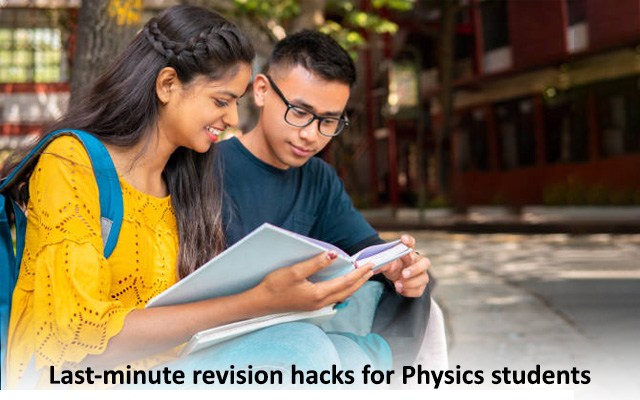
If your exam is days (or hours) away, don't panic — stop trying to cover the whole syllabus and switch to a focused last-minute revision strategy: high-weightage chapters, a one-page formula sheet, active recall, and one timed practice paper. This guide walks you through exactly how.
The exam is close, your syllabus feels endless, and the panic is setting in — sound familiar? You're not alone. Every year, thousands of students sit down two or three days before their physics exam wondering if it's even possible to catch up. The good news: it is. With the right last-minute revision tips for physics, you can still walk into the exam hall calm, focused, and ready to pick up every mark that's within reach. Here's how to make your remaining hours count.
Why Does Last-Minute Physics Revision Feel So Overwhelming?
Physics isn't a subject you can cram by re-reading paragraphs. It's built on interconnected concepts, derivations, and numericals — which means panic-reading the textbook the night before rarely helps. The overwhelm usually comes from trying to do everything at once: re-learning theory, re-deriving formulas, and solving numericals, all in the same sitting. The fix isn't to work harder in the same way — it's to work smarter, with a plan that respects how little time you actually have.
How Should You Plan Your Final Days Before a Physics Exam?
How many days should you set aside for full revision?
If you have 2–3 days left, split your time like this:
Day 1: High-weightage chapters + formula consolidation
Day 2: Numericals and past-year questions from those chapters
Day 3 (or final day): One full timed paper + light formula revision only
If you only have a single day, skip theory entirely and revise formulas, diagrams, and solved examples only.
How do you prioritize chapters by weightage?
Not all chapters are equal. Pull up your board's official marking scheme or previous years' question papers and rank chapters by how often they appear and how many marks they carry. This alone can save you hours — instead of revising 15 chapters evenly, you revise the 5–6 that will actually decide your score.
Which Physics Chapters Should You Focus On for Maximum Marks?
What are the high-weightage topics for Class 10 and 12 boards?
For most boards, these chapters consistently carry the highest weightage:
Electrostatics and Current Electricity
Magnetic Effects of Current and EMI
Optics (Ray and Wave)
Modern Physics (Photoelectric Effect, Atoms, Nuclei)
Mechanics fundamentals (for Class 10/11 syllabi)
Which chapters matter most for JEE and NEET Physics?
For competitive exams, the pattern shifts slightly. Mechanics (especially Rotational Motion and Laws of Motion), Electrostatics, Current Electricity, and Modern Physics tend to carry disproportionate weight year after year. If you're short on time, these are your non-negotiables — and if you want a more detailed breakdown of how to approach them, our guide on building strong physics concepts for JEE goes deeper into sequencing your prep by topic difficulty.
How Can You Revise Formulas Quickly Without Forgetting Them?
A single, well-organized formula sheet is worth more than hours of re-reading. Here's how to build one fast:
- Group formulas by chapter, not randomly — your brain recalls faster when formulas are contextual
- Write them by hand once — the act of writing embeds them better than typing or reading
- Use color coding for units and vector quantities, which are common places students lose marks
- Pair each formula with the one variable it's most often confused with (e.g., linear vs. angular momentum)
Keep this sheet with you at all times in the final 48 hours — glance at it between study blocks instead of scrolling your phone.
What Are the Best Last-Minute Revision Techniques for Physics?
- Active recall over re-reading: Close the book and try to write out a concept or derivation from memory. This exposes gaps far faster than passive reading.
- One timed past paper: Solving a full previous year's paper under exam-like time pressure tells you exactly where you're slow or shaky — more useful than solving ten random questions.
- Mind maps for linked concepts: Physics chapters connect to each other (electrostatics feeds into current electricity, which feeds into magnetism). A simple mind map helps you see the bigger picture instead of memorizing chapters in isolation.
- The Feynman technique for stuck concepts: If a concept isn't clicking, try explaining it out loud in the simplest possible words, as if teaching a younger student. If you can't simplify it, you haven't understood it yet — and now you know exactly what to revisit.
If visual, connected explanations help you more than static notes, it's worth looking at how coaching centers use 3D animations and simulations for mechanics and optics to make these interlinked concepts click faster than text alone.
How Do You Avoid Common Mistakes During Last-Minute Revision?
- Don't start new topics. With limited time, starting something unfamiliar eats time and adds anxiety without guaranteeing marks.
- Don't skip diagrams and derivations. Board exams reward step-marking — a well-labeled diagram or a partially correct derivation still earns marks even if the final answer is wrong.
- Don't ignore units and significant figures. These are the easiest marks to lose and the easiest to protect with a quick final check.
- Don't binge revision videos aimlessly. Passive video-watching feels productive but rarely builds recall. Use videos only for concepts you're genuinely stuck on.
What Should You Do the Night Before and Morning of the Exam?
The night before is for consolidation, not learning. Do a light pass over your formula sheet, skim solved examples you've already practiced, and stop studying at least an hour before bed. Sleep does more for memory retention than one more hour of revision — this isn't a myth, it's how your brain consolidates what you've already learned.
On exam morning, avoid opening new material. A quick formula skim, a calm breakfast, and arriving early with your admit card and stationery sorted will do more for your score than one last numerical.
How Can a Physics Tutor or Coaching Help in the Final Days?
Even with a solid plan, physics numericals can throw up doubts that are hard to resolve alone under time pressure. This is where structured, one-on-one guidance makes a real difference — someone who can quickly spot where you're losing marks and redirect your last hours toward what will actually move your score. If you're preparing for NEET specifically, our detailed NEET Physics preparation strategy breaks down exactly how to structure your final weeks, not just your final days. And if you'd like personalized, personalized Class 11–12 Physics coaching or a focused NEET Physics coaching program to guide your revision, our team can help you build a plan tailored to exactly where you stand right now.
Frequently Asked Questions About Last-Minute Physics Revision
How can I revise the entire physics syllabus in one day?
You can't cover everything — so don't try. Focus only on high-weightage chapters, revise your formula sheet, and go through a handful of solved examples rather than full theory.
What is the best way to revise physics quickly before an exam?
Active recall, a consolidated formula sheet, and one timed past paper will do more in a few hours than passively re-reading the textbook.
Which chapters are most important for last-minute Class 12 physics revision?
Electrostatics, Current Electricity, Magnetic Effects and EMI, Optics, and Modern Physics typically carry the highest weightage.
How many hours should I study physics the day before the exam?
Aim for focused 45–50 minute blocks with short breaks, totaling 5–6 hours maximum. Beyond that, retention drops sharply and fatigue increases error risk.
Can I still score well with only last-minute revision?
Yes, if it's targeted. Prioritizing high-weightage topics and formula recall can meaningfully lift your score even with limited prep time — though it's not a substitute for consistent study over the full term.
How do I memorize physics formulas quickly?
Group them by chapter, write them by hand once, and revisit the same sheet repeatedly rather than switching between multiple sources.
Should I attempt new or unsolved questions the night before the exam?
No. Stick to problems and concepts you've already practiced. New questions add risk without guaranteed reward this close to the exam.
Is it better to revise physics at night or in the morning before the exam?
A light revision session the night before, followed by sleep, works better than cramming right up to the exam. Morning time is best used for a calm formula skim, not new learning.
Final Thoughts: Make Your Last Few Days Count
Running out of time doesn't mean running out of options. A focused plan — high-weightage chapters, a clean formula sheet, active recall, and one timed paper — can meaningfully change your outcome, even in the final 48 hours. Stay calm, stick to what you know, and use every remaining hour with intention.