
Your child may spend hours solving JEE physics questions, yet still feel stuck when the question pattern changes. This usually happens when the concept is weak. That’s why many JEE aspirants and parents look for effective JEE physics preparation tips for strong concept building. With JEE physics concept building, many aspirants recognise patterns, improve accuracy, and approach unfamiliar problems with confidence.
This blog explains why students struggle with difficult JEE physics questions and how concept clarity changes the way they solve problems. You will learn how to strengthen the basics, study important chapters, and how a physics coaching centre for JEE can help.
Why Do JEE Aspirants Struggle With Tough Physics Questions?

Many students believe tough physics questions are difficult because they involve complicated calculations. However, the real challenge is often hidden much earlier — in understanding what the question is actually testing.
A JEE question rarely asks for direct formula application. It combines concepts, conditions, and situations. A simple-looking question may require aspirants to understand force, energy, motion, graphs, or a combination of multiple ideas.
Is It a Concept Problem or a Practice Problem?
A concept problem usually looks like this:
- Your child knows the formula but does not know when to use it
- They cannot identify the physics principle involved
- A small change in the question makes it feel completely new
- Aspirants struggle to explain why a solution works
A practice problem is different. It’s about speed and accuracy.
Why Memorising Formulas Doesn’t Work in JEE Physics
A formula is only useful when aspirants understand the conditions behind it. The same principle can appear in different forms. Work-energy concepts may involve friction, springs, gravity or collisions.
What Does “Concept Building” Actually Mean in Physics?
JEE physics concept building means understanding the reason behind a formula, knowing where it applies and connecting different chapters logically.
A quality physics coaching centre for JEE allows students to visualise what is happening before starting calculations. Students can imagine the direction of force, movement of an object, change in energy, or behaviour of a circuit.
Understanding vs. Solving — What’s the Difference?
Understanding means knowing the answers to:
- Why a particular method is used?
- Which concept controls the problem?
- What changes when conditions change?
- Why one formula works, and another does not?
How Do Toppers Approach a New Chapter?
A practical JEE Advanced physics strategy followed by toppers includes:
- Understanding the basic theory
- Learning important derivations
- Solving simple applications
- Analysing mistakes
- Moving towards advanced problems
How to Build Concepts Step-by-Step Before Attempting Hard Problems?
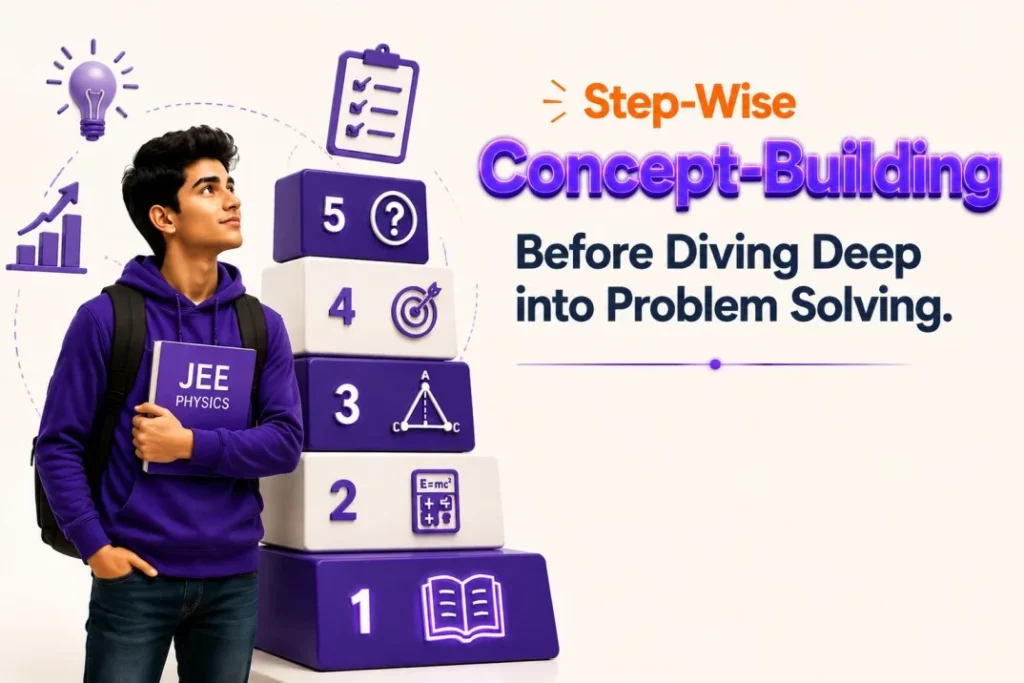
Wondering how to prepare physics for JEE Main? Start with the right sequence. Jumping directly into difficult questions may make preparation feel overwhelming.
A strong approach moves from understanding → practice → application.
Step 1 — How to Read NCERT/Theory the Right Way?
Want to know how to study physics for JEE from basics? Focus on:
- Definitions
- Physical meaning of concepts
- Diagrams
- Examples
- Conditions behind formulas
NCERT helps build fundamental understanding, especially for basic concepts. However, JEE preparation requires additional problem-solving practice because questions often test application.
Step 2 — How to Derive Formulas Instead of Memorising Them?
It’s not required to memorise every formula. Instead, understand:
- The starting principle
- The relationship between quantities
- The assumptions used
For example, knowing a formula for motion is useful. But understanding how it connects displacement, velocity and acceleration helps decide when to use it.
Step 3 — How to Use Diagrams and Visualisation in Physics?
Many difficult questions become easier after JEE aspirants draw the situation properly.
Use:
- Free-body diagrams in mechanics
- Circuit diagrams in electricity
- Ray diagrams in optics
- Graphs for motion and changing quantities
Step 4 — How to Solve Basic/Level-1 Questions First?
Many students make the mistake of choosing advanced books immediately. But difficult questions are built on simple ideas.
Start with:
- Basic concept questions
- Single-concept numericals
- Worked examples
- Previous year questions
Step 5 — When Should Students Move to Advanced/Tough Questions?
Students often ask how to solve tough physics problems at the JEE level. But move to advanced problems when your child can:
- Have clarity about the basics
- Explain the formulas
- Solve standard questions comfortably
- Identify where and how mistakes happened
How to Know If Your Concepts Are Actually Clear?
Conceptual clarity in physics for JEE means students can apply an idea in a new situation instead of repeating a memorised solution.
Self-Testing Methods Before Attempting PYQs
Just think:
- Whether explaining concepts is possible without opening notes?
- Is it possible to predict what happens if a variable changes?
- Is it possible to draw the required diagram?
- Is explaining why a formula works possible?
Students must revisit the concept if answers to the above questions are not found.
How to Use the “Explain It Simply” Technique?
Try explaining a topic in simple language as if one student is teaching another. A professional physics coaching centre for JEE helps at every stage of concept-building.
How to Approach a Tough JEE Physics Question Using Strong Concepts?
A difficult physics question may look complicated because several small ideas are combined. The solution is not to panic. Break the question into smaller parts.
How to Break Down a Complex Problem Into Smaller Concepts?
When learning how to solve JEE physics numericals, follow this approach:
- Read the question carefully
- Identify what is given
- Understand what is being asked
- Find the physics principle involved
- Select the required equations
For example, solving tricky physics problems like Center of Mass becomes easier when your child identifies mass distribution, reference points, and the correct principle before calculating.
How to Identify Which Concept a Question Is Testing?
Do not immediately search for a formula. Students must ask:
- Is this a force problem?
- Is energy changing?
- Is momentum involved?
- Is there a field interaction?
- Is the question based on graphs?
Common Mistakes Students Make While Building Physics Concepts

Knowing the common mistakes JEE aspirants make can help avoid repeating them.
1. Skipping Derivations
Memorising formulas without understanding their origin makes application difficult.
2. Jumping to PYQs Too Early
PYQs are important, but solving them before understanding concepts often creates frustration.
3. Ignoring Units, Signs and Directions
Many students lose marks because of small errors:
- Wrong unit conversion
- Incorrect sign convention
- Ignoring direction
- Skipping diagrams
Best Resources to Build Physics Concepts for JEE
Some useful resources include:
- NCERT for basic understanding
- Structured class notes
- Concept-based videos
- Practice sheets
- Previous year questions
- Mock tests
Do explore more physics preparation guides like this.
Books, Videos, and Practice Sets That Actually Help
Choose resources that explain:
- Why a method works
- How concepts connect
- When a formula should be applied
- How mistakes can be avoided
A structured learning environment, such as JEE physics coaching in Kolkata, can help students combine theory, practice, and regular feedback.
Sample Study Plan — From Concept to Tough Questions
Daily/Weekly Structure to Follow
Daily:
- Learn one concept deeply
- Revise previous topics
- Solve basic application questions
- Note mistakes
Weekly:
- Practise PYQs.
- Analyse mock tests
- Revise formulas and diagrams
- Revisit weak areas
Following a structured study plan for competitive exams helps students maintain balance between learning, practice, and revision.
Finally — Focus on Concepts First, Speed Later
In JEE physics, strong fundamentals help you solve unfamiliar questions, reduce mistakes, and improve confidence. The right JEE physics preparation tips always begin with concept clarity, not just endless practice.
If you want to build a strong foundation and prepare with proper guidance, connect with Study with IB, a trusted physics coaching centre for JEE in Kolkata.
Call now!
What People Also Ask
1. Is NCERT enough for JEE Physics concepts?
NCERT helps understand fundamental concepts. However, JEE Physics requires additional practice, advanced problem-solving, and previous year question analysis.
2. How much time should be spent on concepts before solving problems?
Spend enough time to understand theory, diagrams, and formulas before attempting questions. Strong concepts reduce mistakes later.
3. Should we memorise formulas or derive them for JEE?
Understand the derivation and conditions first. Formula memorisation alone is not enough for JEE-level questions.
4. How to improve problem-solving speed in JEE Physics?
Improve speed by strengthening concepts, practising regularly, analysing mistakes, and learning efficient solving methods.
5. What is the right order to study a physics chapter for JEE?
Start with theory, understand derivations, solve basic questions, practise PYQs, and then move towards advanced problems.
6. Is it possible to skip basic questions and directly practice tough JEE-level problems?
No. Basic questions build the foundation required to solve advanced problems confidently.
7. How to identify which concept a JEE physics question is testing?
Look at the situation described in the question. Identify the physical process involved before choosing formulas.
8. How do toppers prepare physics concepts for JEE Advanced?
Toppers focus on understanding concepts deeply, practising quality questions, revising regularly and analysing mistakes instead of only increasing question numbers.